
17.7 C
London
Sunday, April 12, 2026
secret satire society
Home Blog Page 481

‘Impartial’ BBC Leading Light For ‘StrongerIn’ Campaign

0

When the BBC was first founded on 1 January 1927 it held the mantle of impartiality within its basic framework. Those days are long gone.

Everything about the BBC during the EU referendum campaign is directly in favour and skewed towards the Remain campaign, and it is getting so ridiculous that many people are simply turning off.

With 90% of coverage given to the StrongerIn campaign, there is little or no coverage of any other voices. You don’t see Michael Gove, you don’t see Boris Johnson or Iain Duncan Smith, and you certainly don’t see Nigel Farage.

The BBC’s impartiality statement is:

“Impartiality lies at the heart of public service and is the core of the BBC’s commitment to its audiences.  It applies to all our output and services – television, radio, online, and in our international services and commercial magazines.”

bbc impartial

Are we now living in North Korea or the former Soviet Union, as the BBC adopts a complete Eurocentric biased ethos, disseminating EU propaganda at every turn, and ignoring the other side completely? It is not the British Broadcasting Company any more but the Euro Broadcasting Company.

One can only hope that there is a Brexit, purely to bring some impartiality back to the BBC one day. We are now seeing some kind of independent oversight committee being assembled to watch over the errant corporation, however no one really knows what or who will be manning that operation. Could just be another white wash like so many other Cameron government escapades, all show, no action.

Amongst the thousands of publicly funded civil servants ordered to work for StrongerIn, yes, it is only natural that the BBC was enrolled into the campaign, especially after receiving £2 million from the EU just prior to the referendum was announced.

Well done BBC, although you were once impartial, you are just now a tool for indoctrination. You are no different to the Politburo or Stasi.

Iain Duncan Smith: Cameron Gave Away Britain’s Veto During EU ‘Negotiations’

1

The venue yesterday at Enfield North Conservative club was buzzing with energy as it was packed to the rafters with people eager to listen to Iain Duncan Smith about the upcoming EU referendum on June 23.

Discarding the microphone, IDS jumped straight into an emphatic strong oppositional argument to the terrible travesty of the EU’s constitutional hold over Britain.

The key point that really stood out was revealed mid speech where a blistering IDS tornado revealed that during Cameron’s so-called negotiations, he had given away Britain’s right to veto treaties. This revelation is astounding, because it reveals that if Britain remains in the EU it will have no bargaining chip left, it will simply have to accept every indignity foisted upon it without question. Furthermore, the mainstream controlled media has neglected to report this point and it has been kept secret by the StrongerIn campaign.

Mr Duncan Smith may be portrayed as the quiet man of politics, but he was definitely not quiet about this new revelation which is shocking to say the least. Leaving Britain unarmed without the power of veto will endanger every law, every constitutional point of Britain, surrendering everything to Brussels.

David Cameron’s so-called negotiations were a sham losing Britain’s veto

“We had a right to veto the use of the court and the Commission in application of the Euro area.

“They needed our permission to use those to adjudicate matters in the Euro area.

“One vote was enough to say veto.

“I was told during the negotiations, this didn’t matter any longer, threatening to use it didn’t make any difference, because they’d get it to the court and they’d say no.

“But I knew that the legal advice said differently.”

He said the British Government slashed the number of concessions they wanted to ask for, yet the European Commission only wanted one thing from Britain in the negotiations, and that was to get the veto back.

The former Tory leader, added: “They know that that right to veto gave us quite a strong position to stop development in the European Union which we did not want.

“We have given it away and that makes our position, if we vote to remain, even weaker than it was before.

“So don’t be fooled by the idea that there is some negotiation that we undertook.”

This is why it is imperative that we Vote Leave on June 23. To not do so will leave Britain completely vulnerable to the EU’s will. This vote is going to be the most important vote of your life. Think of your children, think of your grandchildren and their future.

Your vote will determine whether Britain lives or dies. This is our last chance.


Vote Leave Hits Back at BSE Campaign Poster


Responding to David Cameron unveiling a new Britain Stronger in Europe (BSE) campaign poster, Vote Leave is today publishing a series of graphics that highlight the costs of voting to remain in the EU. These include:

The cost of staying in the EU: £4,600 for every household

The cost of EU membership: £50 million every single day

The cost of EU membership: 250,000 EU immigrants every single year


Commenting, Vote Leave Chief Executive Matthew Elliott said:


‘David Cameron knows that not a single British family would lose that amount of money if we Vote Leave. In fact they would prosper as we spend our money on our priorities. Sadly, he failed to win even the most modest reforms to the EU in the renegotiation. He failed to keep his promise and make a positive case for the EU, choosing instead to do down Britain. Now he’s failing to be honest with hardworking families about the costs of the EU.


‘We hand £50 million to Brussels every day while EU regulations undermine our economy, democracy and borders. On 23 June it is safer to take control and Vote Leave.’

4_300_Poster_Digi_VL1


The cost of staying in the EU: £4,600 for every household (Source: HM Treasury)

In 2005, HM Treasury admitted that: ‘although Europe’s founders aimed to remove barriers and reap the benefits of expanded markets internally, they also sought protection and special treatment for particular aspects of their economies such as agriculture. This has brought costs: expensive subsidies still remain in some sectors and it is estimated that barriers to external trade and investment – such as tariffs, quotas and unjustifiably restrictive standards – could cost Europe’s consumers up to 7 per cent of EU GDP’.

This is the equivalent of £125.2 billion per year in today’s prices, or £4,638 per household.

4_300_Poster_Digi_VL3

The cost of EU membership: £50 million every single day (Source: Office for National Statistics)

In 2014, the UK paid £19.107 billion (gross) to the EU institutions.

This is the equivalent of £367.4 million per week, or £52.3 million per day.

The Head of the Statistics Authority, Sir Andrew Dilnot CBE, has said ‘Yes, the £19.1 billion figure is a legitimate figure for gross contributions … the official statistics are the £19.1 billion’.

4_300_Poster_Digi_VL2

The cost of EU membership: 250,000 EU immigrants every single year (Source: Office for National Statistics)

In the year ending September 2015, the inflow of EU migrants was 257,000.

This is equivalent to a city the size of Newcastle, Plymouth, or Wolverhampton.


The Government and BSE’s £4,300 figure is bogus


The Government calculates the £4,300 figure by dividing a putative 6% lesser increase in GDP growth by 2030 by the current number of households.

The Government divides the putative lesser increase in GDP of 6.2% by the current number of households.

This is extremely disingenuous, as official statistics show that the number of households in 2030 is projected to grow to 31.213 million. This is up from 26.994 in 2015, an increase of 4.219 million.


The report fails to consider the costs of EU regulation, which the Treasury has previously admitted are as high as 7% of GDP, or £4,638 per household.

The report does not quantify any potential savings of not having to apply EU regulation in the UK, but instead claims regulation would increase if we Vote Leave.

The report asserts that: ‘under any of the alternatives, the potential gains from additional flexibility on leaving the EU are likely to be significantly constrained, including because of domestic priorities and international obligations. These would be future government decisions. In any case, any potential gains from reduced EU regulatory burdens in specific areas would be significantly outweighed by the losses from the increased regulatory barriers and divergence from no longer being a member of the Single Market. Consistent with this assessment and the approach throughout this analysis, the modelling does not prejudge these decisions and no further assumptions on regulation are made over and above the increase in regulatory barriers that would emerge over time, as captured in the modelling of the effects of the alternative arrangements on trade and FDI’.

In 2005, HM Treasury admitted that: ‘although Europe’s founders aimed to remove barriers and reap the benefits of expanded markets internally, they also sought protection and special treatment for particular aspects of their economies such as agriculture. This has brought costs: expensive subsidies still remain in some sectors and it is estimated that barriers to external trade and investment – such as tariffs, quotas and unjustifiably restrictive standards – could cost Europe’s consumers up to 7 per cent of EU GDP’.

This is the equivalent of £125.2 billion per year in today’s prices, or £4,638 per household.

This is likely an underestimate, as the burden of EU regulation has increased. Open Europe‘s regular analysis of the cost of just the 100 most burdensome EU laws found in 2013 that the cost to the UK economy was £27.5 billion, but just a few months later had to uprate this to £33.3 billion.


The £4,300 figure is based on the Government breaking its promise to reduce net migration to the tens of thousands in every year of this Parliament.

The Government’s document states that: ‘The population and migration projections which underlie the modelling were used by the OBR in their Economic and fiscal outlook accompanying Budget 2016. It is assumed that population growth will slow in line with the ONS’s current principal population projections. In the principal projection, total net international migration to the UK falls from 329,000 per year in 2014 towards 185,000 per year from 2021 onwards’.

The OBR’s central forecast is that net migration will be in excess of the 100,000 target in every year of this Parliament, contrary to the Government’s manifesto.

The 2010 Conservative Manifesto promised that ‘we will take steps to take net migration back to the levels of the 1990s – tens of thousands a year, not hundreds of thousands’.

The 2015 Conservative Manifesto pledged to ‘keep our ambition of delivering annual net migration in the tens of thousands, not the hundreds of thousands’.

The lowest net migration has been since 2010 was 177,000 in 2012. Net migration in 2014 was 313,000, of which 174,000 persons came from the EU.

In her speech to the 2015 Conservative Party conference in Manchester, the Home Secretary, Theresa May, said: ‘not all of the consequences can be managed, and doing so for many of them comes at a high price… But even if we could manage all the consequences of mass immigration, Britain does not need net migration in the hundreds of thousands every year… The evidence – from the OECD, the House of Lords Economic Affairs Committee and many academics – shows that while there are benefits of selective and controlled immigration, at best the net economic and fiscal effect of high immigration is close to zero.  So there is no case, in the national interest, for immigration of the scale we have experienced over the last decade. Neither is it true that, in the modern world, immigration is no longer possible to control… The numbers coming from Europe are unsustainable and the rules have to change’.


If there were 6% fewer households in 2030 due to lower immigration, there would be no reduction in household income at all (even assuming the Treasury are right that the economy would be 6.2% smaller in 2030 than it otherwise might have been).

The number of households in 2030 is projected to grow to 31.213 million. A 6% reduction in this forecast means 29.340 million households in the UK in 2030, an increase of 2.346 million households compared to today.

This means that even if household numbers grow by more than 2.3 million in the next fifteen years, the Treasury is forecasting no reduction in household incomes.


The report does not consider the benefits of striking free trade deals.


The report assumes the UK would strike no new free trade deals if we Vote Leave, despite this being one of the principal economic benefits of leaving the EU.

In 2015, the aggregate GDP of all the countries with which the EU had a trade agreement in force was $7.7 trillion.

By contrast, the aggregate GDP of all countries with which Chile had trade agreements was $58.3 trillion. The figure for South Korea was $40.8 trillion and that for Switzerland was $39.8 trillion.

The EU has failed to negotiate a free trade agreement with China. By contrast, both Iceland (which has a population of less than half a million) and Switzerland have negotiated free trade agreements with China.


The report downplays the savings from the UK’s budget contributions.

The report claims that the UK’s net contribution to the EU in 2014 was £5.71 billion.

The report admits that the contribution is a ‘significant economic obligation‘.

In 2014, (the last year for which data are available), the UK recorded a £12.3 billion balance of payments deficit with the EU institutions.

This is the net sum of money paid by the UK to the EU institutions in 2014. This money would be retained in the UK if we Vote Leave, cutting the current account deficit.

In addition, the UK would regain full control of the £19.1 billion we currently send to Brussels.

Lord Lamont Responds to the IMF Scaremongering Propaganda

0


Responding to the comments from Christine Lagarde of the IMF, former Chancellor of the Exchequer Lord Lamont of Lerwick said:

 
“This daily avalanche of institutional propaganda is becoming ludicrous and pitiful. Important institutions are being politicised and used to make blood-curdling forecasts. There are plenty of respected individual economists, plenty of respected professional investors, and plenty of entrepreneurs who take a very different view from Christine Lagarde and who have probably been better at foreseeing the future than the IMF.
 
“Not so long ago the Chancellor was berating the IMF for being too pessimistic about the British economy. Now the Government is cheering it on. Madame Lagarde says that what happens in Britain will affect other countries in Europe, including her own country France. Perhaps what she is really afraid of is that if Britain leaves the EU other countries in the EU will also want to hold referendums on their membership.”

EU-Funded IMF Being Used to Bully the British people


  • The Government is planning to circumvent purdah rules by using the IMF, which is funded by the EU and the UK Government.
  • The IMF has been consistently wrong about its forecasts for the UK economy. It is wrong now. The Chancellor has castigated the IMF for its errors in the past.
  • The IMF recommends tax hikes on items such as food and childrens’ clothing if we vote ‘IN’.
  • Most of the IMF’s specific claims are contradicted by pro-EU campaigners, such as the Government and the Bank of England.
  • The European Commission and Parliament are planning to take the UK’s seat on the IMF if we vote to stay.
  • Christine Lagarde is facing serious criminal allegations.


Responding to the IMF’s assessment of the UK economy, Priti Patel MP said:


‘The IMF warned Britain it was playing with fire when it set out a plan to deal with the deficit. Now our economy is stronger than nearly every other major economy. Today, the IMF is talking down Britain because we want to take back control from Brussels. They were wrong then and they are wrong now.

‘The EU-funded IMF should not interfere in our democratic debate a week before polling day. It appears the Chancellor is cashing in favours to Ms Lagarde in order to encourage the IMF to bully the British people – it is a sign of the desperation in the IN campaign.’


The IMF has announced that it plans to intervene in the purdah period. The IMF is not ‘independent’, but is funded by the EU. Lagarde is an employee of Osborne.

In her remarks to journalists this morning, Christine Lagarde confirmed that the IMF would release a report warning against a leave vote one week before the referendum.

This will be during the 28 day purdah‘ period which prohibits public authorities from publishing information pertaining to the referendum. The purpose of the rules is to stop taxpayers’ money being spent on campaigning.

The IMF is taxpayer funded but has nevertheless made clear its intent to interfere in the debate. According to the Commission’s own transparency system, the IMF has received €168,138 from the European Commission since 2007.

George Osborne is one of the voting members of the IMF Board of Governors and has 203,004 votes.


Christine Lagarde is a long-standing pro-EU campaigner, who believes the law should not be followed when it is inconvenient.

Ms Lagarde has said ‘we would like to see the euro zone be much more integrated‘.

She has argued that the law should be violated to further political ends, stating: ‘We violated all the rules because we wanted to close ranks and really rescue the euro zone. The Treaty of Lisbon was very straight-forward. No bailout’.

She is a noted supporter of greater European integration with her proposals dubbed as steps ‘towards a United States of Europe‘.

She has said that uncontrolled immigration in the Schengen area has ‘upside potential’.


Christine Lagarde is facing serious criminal allegations.

Christine Lagarde has been charged with negligence by a French court over her alleged role in the payment of £293 million to a French businessman, Bernard Tapie. The French Republic has since ordered Mr Tapie to repay the money.

If convicted, Ms Lagarde could face up to a year’s imprisonment. The case continues.


The IMF recommends tax hikes if we vote ‘IN’.

The IMF recommends ‘measures such as scaling back distortionary tax expenditures (e.g., nonstandard VAT rates), which would also increase economic efficiency and tax neutrality.’

This could mean the imposition of VAT on food, books and childrens’ clothing, a massive tax hike for working families. In January this year, the Economics Commissioner, Pierre Moscovici, called for further harmonisation of taxation, including scrapping the UK’s zero rates, stating a ‘zero rate is not the best idea’.


The IMF has been consistently wrong about its forecasts for the UK economy. It is wrong now.

The IMF has tried to talk Britain’s economy down before – but its negative forecasts for the UK economy have been consistently wrong. In 2013 the IMF’s chief economist, Olivier Blanchard, warned that Britain’s growth prospects were very low. When challenged, the Chief Economist responded: ‘I am right and they are wrong’. His estimates turned out to be inaccurate and UK growth was much stronger than he predicted.

The IMF later had to accept that it was wrong about its warnings for the UK. Christine Lagarde later admitted that she had ‘underestimated‘ the strength of growth when the IMF assessed the UK economy in 2013.

The IMF has made other major errors of forecasting. In June 2013, the IMF was forced to admit it had issued ‘economic projections that were too optimistic’ about its joint austerity programme with the EU in Greece.


Even the Head of the IN campaign has dismissed siren voices like the IMF’s. The Chairman of the IN campaign, Lord Rose of Monewden, has admitted that there are no short-term risks in voting to leave, stating: ‘Nothing is going to happen if we come out of Europe in the first five years … There will be absolutely no change … It’s not going to be a step change or somebody’s going to turn the lights out and we’re all suddenly going to find that we can’t go to France, it’s going to be a gentle process’.


The Chancellor of the Exchequer has previously been very critical of the IMF.

In April 2014, the Chancellor made a speech to the American Enterprise Institute which was widely perceived to be a direct attack on the IMF for its previous negative forecasts about the British economy. Mr Osborne said: ‘pessimistic predictions that fiscal consolidation was incompatible with economic recovery have been proved comprehensively wrong by events… many of those same pessimists have now found new grounds to be gloomy about our future… I want to explain why I believe both of these predictions will be proved wrong too… I have a different prescription. My message today at the IMF is this. The pessimists said our plan would not deliver economic growth. Now they say economic growth will not deliver higher living standards. They were wrong about the past and they are now wrong about the future’.


The IMF is wrong about the effect of leaving the EU on the current account. This undermines all its subsequent predictions about the impact of a vote to leave the EU.

The IMF argues that it would be more difficult to finance the current account deficit in the event of a vote to leave the EU. The UK recorded a current account deficit of £96.3 billion in 2015.

The current account deficit could be substantially reduced if we Vote Leave. In 2014 (the last year for which data are available) the UK recorded a £12.3 billion balance of payments deficit with the EU institutions. ONS figures released in March 2015 show the UK Government paid the EU institutions (net) £10.6 billion in 2015 (this figure excludes payments by the private sector to the EU institutions).

This means we could substantially cut the current account deficit if we Vote Leave.

The EU-funded Oxford Economics group has concluded that if the UK voted to leave the EU, ‘in most cases (five out of nine), the UK’s trade balance improves’.


The IMF is wrong that the prospect of leaving the EU ‘already appears to be having an impact on investment and hiring decisions’.

The Bank of England stated yesterday that ‘interest rates appear to have moved little in response to referendum-related news’ and that there is an ‘absence of a clear effect on interest rates… The impact of the referendum on equity prices is also difficult to quantify’ and that there is nothing to ‘suggest any clear referendum impact’.

The IMF even attributes recent trends in the commercial real estate market to the EU referendum. This is despite the Monetary Policy Committee of the Bank of England’s admission yesterday that it was ‘unclear’ to what extent property transactions were being affected by the referendum.

The Bank of England has said there is: ‘little evidence across the range of indicators that… uncertainty surrounding the outcome of the referendum on the UK’s membership of the EU had much affected job creation’.


The IMF’s claim that the largest risk to the economy is the EU referendum is contradicted by the Bank of England.

The Governor of the Bank of England has said that ‘the global risks, including from China are bigger than the domestic risk [of the referendum]’.


The IMF is wrong about house prices.

The IMF is wrong to claim that leaving the EU ‘could entail sharp drops in equity and house prices’.

Philip Shaw, Chief Economist at Investec Bank, has said: ‘I don’t necessarily see a massive impact on house prices. In the UK domestic property market, the biggest driver is demographics and regulation‘. He has also claimed interest rates could be cut, stating that ‘is a risk’.

The Council of Mortgage Lenders has said: ‘As a relatively small, open economy and a major financial centre, the UK has, and will continue to have, close links with global economies, including those within the EU. There is no simple answer to the question of how Brexit might affect housing and mortgage markets’.


The Government has said the IMF is wrong that ‘ratification of a new deal would require unanimous consent of all EU member governments’.

A withdrawal agreement under article 50 of the Treaty on European Union (TEU) is subject to qualified majority voting, not unanimity in the EU Council.

As the Government has acknowledged, ‘The final agreement would need to be agreed by both parties: the EU side and the departing Member State. On the EU side, this would require an enhanced qualified majority among the remaining Member States. This means that no single Member State could veto the deal‘.

Even if a separate deal to the withdrawal agreement were required (a point on which there is some legal uncertainty), the Government has admitted that: ‘an agreement focused solely on trade would need to be approved by the European Parliament and a qualified majority of the Council’.


The IMF is wrong about the future nature of the UK’s relationship with the EU – as the IN campaign has acknowledged.

The IMF claims that a ‘vote to leave the EU would create uncertainty about the nature of the UK’s long-term economic relationship with the EU and the rest of the world’. This is wrong.

The Prime Minister, David Cameron, has admitted: ‘If we were outside the EU altogether, we’d still be trading with all these European countries, of course we would … Of course the trading would go on … There’s a lot of scaremongering on all sides of this debate. Of course the trading would go on’.

The UK’s former Ambassador to the EU and leading supporter of the BSE campaign, Lord Kerr of Kinlochard, has admitted: ‘there is no doubt that the UK could secure a free trade agreement with the EU. That is not an issue‘.

Even the pro-EU CBI has said: ‘the UK is highly likely to secure a Free Trade Agreement with the EU, and such an agreement would be likely to be negotiated at an extremely high level of ambition relative to other FTAs [free trade agreements]’.

The pro-EU Centre for European Reform has accepted that, ‘given the importance of the UK market to the eurozone, the UK would probably have little difficulty in negotiating an FTA‘.

The Foreign Secretary, Philip Hammond, has admitted that a free trade agreement in goods ‘would be relatively simple to negotiate’.


The IMF is wrong that London’s status as a global financial centre could be ‘eroded’ due to a loss of passporting rights.


Switzerland exports a higher proportion of financial services to the EU, despite an absence of passporting rights for its banks. The OECD has noted that: ‘the EU absorbs around 45% of Swiss exports of financial services, despite the absence of passporting rights for its banks’. In 2014, exports to the EU of financial services, insurance and pensions represented 33% of the UK’s exports in those sectors.

Mutual recognition agreements could be agreed if we Vote Leave. The Government has admitted: ‘the EU has “equivalence regimes” to allow financial services firms outside the EU to trade with the Single Market in a way that is similar to the EU financial services passport. It does this through assessing whether a country’s regulatory regime is equivalent to EU rules in the area’. The EU-Canada free trade agreement contains a chapter on financial services.

It is in the EU’s interests to continue to secure access to the world’s largest capital market. As the Governor of the Bank of England, Dr Mark Carney, has said: ‘The comment I would make is that mutual recognition arrangements are possible to achieve‘. There is no prospect of EU Governments wanting to restrict the access of their banks to the City of London.

As the Chairman of the IN/BSE campaign, Lord Rose of Monewden has said: ‘We are very good at what we do in terms of financial services. They cannot do without us‘. It will be in the interests of EU negotiators for the UK to retain ‘passporting’ rights, as key European firms ‘passport’ their services into London.

According to the Bank of England, in September 2015, 75 banks located in the European Economic Area ‘passported’ their services into the UK, including ABN AMRO, BNP Paribas, Deutsche Bank and Société Générale. In addition, almost 800 insurance firms in the EEA could passport their services into the UK as of July 2015.


The European Commission has already announced it intends to silence the UK’s voice in the IMF.

The EU’s blueprint for further integration and future Treaty change, the Five Presidents’ Report, calls for common EU representation ‘in the international financial institutions’ rather than letting individual member states speak for themselves. It suggests that the EU’s ‘fragmented voice means the EU is punching below its political and economic weight’ and specifically singles out the IMF as one such example.

In October 2015, the European Commission proposed a Council Decision to establish unified representation of the euro area in the IMF. The draft Decision, on which the UK will not have a vote, states that: ‘Close cooperation with non-euro area Member States shall be organised within the Council and the [Economic and Financial Committee], on matters related to the IMF. Common positions shall be coordinated on matters relevant for the European Union as a whole’.


The European Parliament has voted for the UK to be silenced in the IMF last month.

In April, the European Parliament called for the EU to ‘seek full membership of international economic and financial institutions where this has not yet been granted and is appropriate (e.g. in the cases of the OECD and the IMF)’.

The Parliament demanded that there should be ‘a single European Union constituency in the long term’, with voting in the EU Council ‘moving away from consensus to a weighted majority voting system‘.


The European Court will force this through.

In an October 2014 decision, the European Court ruled, rejecting the UK’s arguments, that the EU may require the UK to adopt a common EU position in an international organisation of which the EU is not a member, provided that the subject matter of the decision relates to an EU legislative competence. As a result, the UK was forced to adopt an EU common position in International Organisation of Vine and Wine.

Since the EU has legislative competence over financial services, the UK could be forced to adopt a common EU line in the IMF whenever the EU wants.

Publication of NI Number Registration Statistics by the Office for National Statistics Reveal Scale and Impact of Immigration

0

.


Responding to the publication of national insurance number registration statistics by the Office for National Statistics (ONS), Employment Minister Priti Patel said:


‘These figures – which had to be dragged out of the government – show the scale and impact of immigration from the EU is even higher than previously admitted. It is out of control – and cannot be controlled as long as we stay in the EU. This puts huge strains on the NHS, housing, schools and other public services.


‘Short term migration is highly significant, and arguably most damaging in terms of wages and work conditions. The only way we can take back control, and deliver on our manifesto commitment to reduce migration is to Vote Leave on 23 June.’


The Office for National Statistics (ONS) has released a note on the difference between National Insurance number registrations and the estimate of long-term international migration.


These statistics do show that the International Passenger Survey is underestimating the scale of migration into the UK.

In the four years ending June 2014, there were 739,000 gross EU migrants according to the International Passenger Survey (IPS). There were 1.537 million NI no. registrations.

The ONS states that: ‘HMRC also shared with us analysis of those who had arrived, or registered for a NINo in the 4 years, to 2013-14 and were subject to income tax NICs and, or received HMRC benefits at some point in 2013/14 – the latest year available. They found 1.0 million such individuals were from the EEA’.

Even accounting for short-term migration, this suggests that there is a 261,000 disparity between the IPS and the true level of long-term migration, the equivalent of a city the size of Newcastle.

The figures reveal the high-level of short term migration, which has a corrosive impact on people’s wages and rental prices.

The report states that: ‘Short-term migration to the UK largely accounts for the recent differences between the number of long-term migrants (as estimated by the International Passenger Survey (IPS)) and the number of National Insurance number (NINo) registrations for EU citizens’. This confirms that EU migrants who are coming to the UK for short periods are registering for work, putting a downward pressure on wages.

It is well established that having more people in the workforce drives down wages. The Bank of England has found that ‘the immigrant to native ratio has a small negative impact on average British wage’. The study found that ‘immigrants in recent years are most predominant in low-skill occupations’. The study concluded that: ‘the biggest effect is in the semi/unskilled services sector, where a 10 percentage point rise in the proportion of immigrants is associated with a 2 percent reduction in pay’.

The head of the BSE campaign, Lord Rose acknowledged this and admitted wages will go up’ if we Vote Leave, stating: ‘If you are short of labour, the price of labour will go up’.

BlackRock Investment also admitted the same thing.

The report concludes that the Government does not understand the nature of migrants who enter and leave the UK several times a year.

The report concludes that ‘more analysis will take place to better understand what administrative sources tell us about migration patterns, particularly migrants who may enter and leave the UK several times within a year’.

The Government has failed to reduce net migration to the tens of thousands, despite the Prime Minister and the Home Secretary’s repeated promises.

The 2010 Conservative Manifesto promised that ‘we will take steps to take net migration back to the levels of the 1990s – tens of thousands a year, not hundreds of thousands’.

In his 2014 conference speech, Cameron said: ‘numbers that have increased faster than we in this country wanted at a level that was too much for our communities, for our labour markets. All of this has to change – and it will be at the very heart of my renegotiation strategy for Europe. Britain, I know you want this sorted so I will go to Brussels, I will not take no for an answer and when it comes to free movement – I will get what Britain needs’.
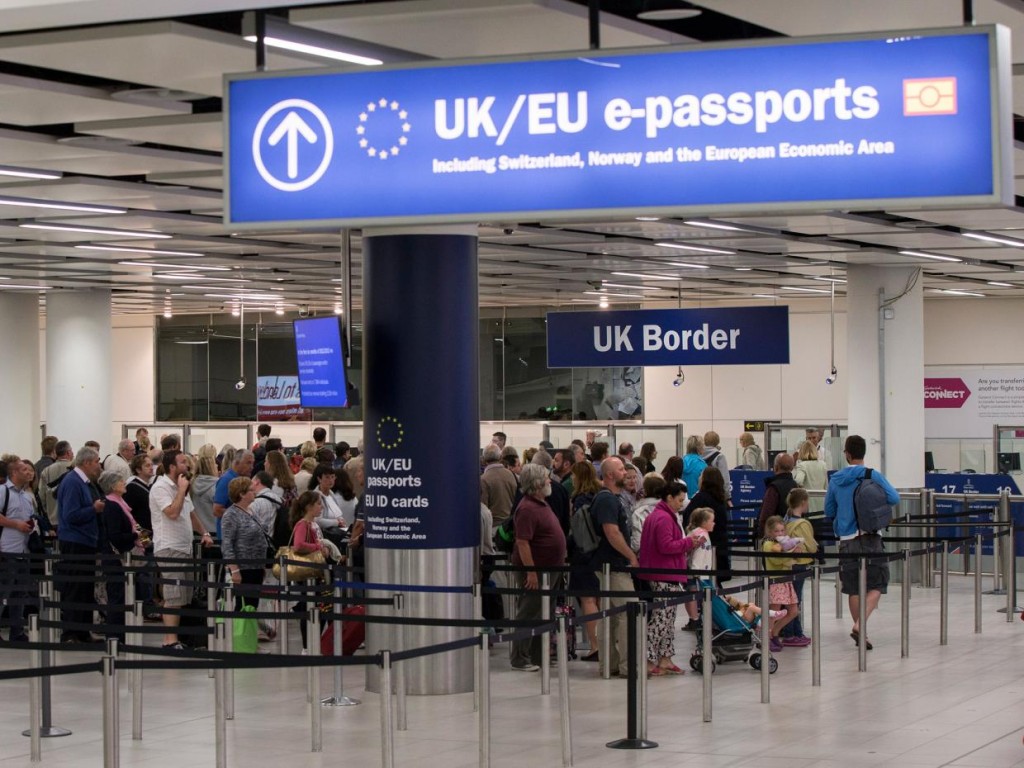
The 2015 Conservative Manifesto promised to ‘keep our ambition of delivering annual net migration in the tens of thousands, not the hundreds of thousands’.

In her 2015 conference speech, the Home Secretary, Theresa May, said: ‘Britain does not need net migration in the hundreds of thousands every year… at best the net economic and fiscal effect of high immigration is close to zero.  So there is no case, in the national interest, for immigration of the scale we have experienced over the last decade.Neither is it true that, in the modern world, immigration is no longer possible to control’.

The lowest net migration has been since 2010 was 177,000 in 2012. Net migration in 2014 was 313,000, of which 174,000 persons came from the EU.

The Government has dropped a key promise that EU migrants must have a job offer to come to the UK.

In November 2014, the Prime Minister promised that ‘we want EU jobseekers to have a job offer before they come here’.

The Home Secretary, Theresa May, has argued: ‘when it was first enshrined, free movement meant the freedom to move to a job, not the freedom to cross borders to look for work… we must take some big decisions, face down powerful interests and reinstate the original principle underlying free movement within the EU’.

The Chancellor of the Exchequer, George Osborne, has said: ‘What we’re going to address is this question of how freedom of movement operates in the 21st century. It was never envisaged that you would have such large numbers of people coming, people coming who don’t have job offers‘.

The renegotiation agreement notes that EU citizens are ‘entitled to reside… [in the UK] solely because of their job-search’.

ONS statistics (which are likely to be an underestimate) show that in the year ending September 2015, 69,000 EU citizens entered the UK ‘looking for work’. If the number of EU jobseekers entering the UK over the next decade remains at current levels, 690,000 persons would be added to the UK population as a direct result. This would be the equivalent of a city the size of Glasgow.

The Government has dropped a key promise that all EU jobseekers must leave the UK after six months.

In November 2014, the Prime Minister promised that ‘if an EU jobseeker has not found work within six months, they will be required to leave‘.

This is illegal under EU law. In 1991, the European Court ruled that the Treaties forbid the removal of jobseekers from another EU member state, regardless of the duration of their stay if ‘the person concerned provides evidence that he is continuing to seek employment and that he has genuine chances of being engaged’.

The Government admitted in December that many EU migrants can ‘keep the status of jobseeker for longer than six months’.

The ’emergency brake’ will have no impact on migration.

In December, one of the top three members of the independent Office for Budget Responsibility, Sir Stephen Nickell CBE, has said changes to migration would have ‘not much’ impact on migration.

Oxford University’s Migration Observatory concluded that the proposed welfare reforms are ‘unlikely’ to ‘lead to a large reduction in EU migration to the UK’.


Brexit the Movie: Into the Belly of the EU Beast – A Must Watch

10

Brexit the movie, is a clearly defined analysis of the EU project and delves deeply into the dark world of the monolithic faceless EU technocratic structure.

The EU is a machine, it processes nations, strips them of their sovereignty, cleans out the innards of financial institutions of those former nations, and amalgamates the spoils into one singular EU black hole where the pampered MEPs and faceless eurocrats eat their caviar,  guzzle on champagne, and chuckle to themselves as they peruse the overblown pay cheque which just landed on their laps courtesy of the taxpayer.

“We decide on something, leave it lying around, and wait and see what happens. If no one kicks up a fuss, because most people don’t understand what has been decided, we continue step by step until there is no turning back.”  EU President, Jean Claude Juncker

In relative terms, Britain has its last chance before it is unceremoniously eviscerated once and for all. Betrayed by part of the population who were fooled by the scaremongering, or just too lazy to find out the real facts; the EUs technique of control relies on the populace of a nation betraying their own countrymen to take over. This we call mind control, and the EU is very effective at mass indoctrination, provokatsiya, zakazukha within the education system and propaganda filled controlled media.

The EU does not stand for democracy and its MEPs revel in this unaccountability, it gives them free reign to do as they please, whilst enjoying the spoils of the taxpayer cash cows.

“If it’s a Yes, we will say ‘on we go’, and if it’s a No we will say ‘we continue’,” EU President, Jean Claude Juncker

To punish Britain is to vote to stay in such a totalitarian entity, where freedom of speech will dissolve completely, where there will be no choice, there will be no mercy to the proletariat, just a cold boot in the face.

George Orwell would have understood the EU very well, as would Karl Marx, and Josef Stalin. Merkel, the current head of the Germanic empirical EU was trained in East Germany under the communist regime, and she is now head of a communist soviet entity called the EU.

“There can be no democratic choice against the European treaties.” EU President, Jean Claude Juncker

When the EU army grows further in strength, your children, and your grandchildren will pledge allegiance to the EU flag as they are conscripted to fight on the Russian front. The Bundeswehr, will eagerly accept your sons and daughters to be used as cannon fodder, to have their blood spilled across the Siberian snow, or to freeze to death, their bodies left to rot amongst the other EU conscripts.

We dare you to vote to remain in the EU, a monstrous evil entity that abhors any form of democracy, and resembles the Borg with its assimilation of all into the behemoth of Baal. Brexit is the only answer.


Skewed EU Referendum: Vote Leave Statement on ITV’s Decision to Allow the Prime Minister to Decide his Debate Opponent

0

Everything about this EU referendum from the start has been skewed in favour of the Remain campaign.

The biased pro-EU BBC received £2 million from the EU just before the announcement of the referendum. Goldman Sachs, Citi bank, Lloyds and JP Morgan are putting vast sums of money into the campaign. The Project Fear daily announcements spouting ‘fearful’ false propaganda headlines. The PM’s announcement that there were no Brexit plans by the government early in the campaign reveal that the EU referendum was from the start a completely skewed unfair playing field.

The final icing on the cake is David Cameron choosing his live TV debate partner, and shying away from the official Leave Campaign representative who could cause real damage to his flawed fearmongering campaign.


No Level Playing Field


Commenting on ITV’s decision to allow the Prime Minister to decide his opponent in the referendum TV debates, a Vote Leave official spokesman said:


‘The Government has set all the rules for the referendum to give itself every possible advantage. It has also demanded of the broadcasters that the Prime Minister should not have to debate representatives from the official Leave campaign.


‘ITV has accepted the Prime Minister’s demands without even discussing it with the official campaign and has allowed the Prime Minister to dictate his own opponent. Since the campaign began, ITV has also given twice as much airtime to the IN campaign than to the Leave campaign.


‘We think that the Prime Minister ought to debate the representative of the official Leave campaign. In a serious democracy, the Government should not be allowed by a free media to pick its own opponents in the official debates on the most important political decision in decades.


‘We are discussing legal possibilities to increase the chances that the public will hear the issues properly discussed before they make such an important vote on the future of their democratic rights.


‘The reason for the timing of the announcement is the Government’s desire to distract attention from the immigration figures being released today. We hope that ITV covers that story properly.’

Lord Owen: ‘We are in a David vs Goliath fight, but it is one we are determined to win – for the good of the British people’


  • Today, the Electoral Commission published details of donations and loans to the EU referendum campaigns.

  • Just four donors to the Britain Stronger in Europe (BSE) campaign, Goldman Sachs, JPMorgan, Morgan Stanley and Citi, have had to pay a total of $27.7 billion to the US Government for their role in causing the global financial crisis in 2008.

  • The US Government had stated that all of these banks contributed to the financial crisis by misselling toxic mortgages. Goldman Sachs also cooked the books to allow Greece to join the single currency.

  • In 2015, the four banks spent collectively as much as €5.25 million lobbying the European Commission. Each bank spent at least €1 million.

  • Goldman Sachs and JPMorgan were supportive of the UK’s entry into the single currency, as was Citi’s current Chief Economist who predicted Greece would leave the euro by 1 January 2013.

  • Lloyds Bank Plc (which had to be bailed out by the taxpayer and was involved in the LIBOR) has lent the BSE campaign £20,000 at just 1% interest.

  • The BSE campaign has also accepted donations from companies which are majority owned by foreign governments, companies based offshore, a company owned by a Russian oligarch linked to ‘a campaign of state-sponsored harassment’ and supporters of and donors to the pro-euro campaign fifteen years ago.

Commenting, former Labour Foreign Secretary Lord Owen said:


‘The EU works in the interests of the elite – the one per cent – so it is entirely unsurprising to find that the campaign to keep us in the Union is financed by big banks like Goldman Sachs and JP Morgan.


‘With their unlimited cash, they are lobbying the British people to act in a way that benefits their profit margin. Remember, these banks are the very people who crashed the economy in 2008 – misselling toxic mortgages, and cooking the books to allow Greece to join the single currency. Millions of ordinary people paid for their mistakes – and many are still suffering.


‘The truth is that Wall Street’s predatory habits have played an important, although little recognised, role in the Eurozone crisis. Yet, today, Goldman Sachs have the brass cheek to lecture us in the UK on why we should stay in an EU damaged and rendered virtually dysfunctional by the Eurozone crisis.


‘These figures show again that we are in a David vs Goliath fight, but it is one we are determined to win – for the good of the British people. They are the ones who pay the costs of uncontrolled migration – through lower wages, and unsustainable pressure on public services such as schools and hospitals. Now is the opportunity for them to strike back – and reclaim control of the £350 million we send to the EU every week, to spend it on their priorities instead.’


bribe-5

EU lobbying by BSE’s donors and the fines they paid for causing the financial crisis


The table summarises the amount spent by these giant banks on lobbying the EU, and the fines and settlements they made in reparation to the US Government for causing the financial crisis.


Lobbying (2015)

Fines and settlements for causing the financial crisis

Low (€m)

High (€m)

$bn

Goldman Sachs

€ 1.00

€ 1.25

$5.1

JPMorgan

€ 1.25

€ 1.50

$13

Morgan Stanley

€ 1.00

€ 1.25

$2.6

Citi

€ 1.00

€ 1.25

$7

Total

€ 4.25

€ 5.25

$27.7

Source: European Commission, US Department of Justice.


Goldman Sachs campaigned for the single currency.

Peter Sutherland, Chief Executive of Goldman Sachs International sat on the Council of Britain in Europe, the failed campaign to scrap the pound and to ratify the European Constitution.

Mr Sutherland was a vocal supporter of the single currency: ‘[F]ormer European commissioner Peter Sutherland, who is now chairman of the investment bank Goldman Sachs International. Mr Sutherland said it had been a tragedy that Britain had stood apart during the early formative years of European integration and had often appeared to be a semi-detached participant in the process. “An opt-out from the single currency will exacerbate the impression and the reality of this detachment and inevitably will reduce the influence of Britain at a time of fundamental change both within Europe and globally,” he added. “It is surely essential that the United Kingdom should seek to advance its influence and the irony is that British influence over its own destiny in all economic areas, including currency, is enhanced rather than eroded by pooling sovereignty”‘ (Press Association, 12 November 1996).

Corruption

Goldman Sachs cooked the books to allow Greece to join the euro.

Goldman Sachs helped the Greek government to mask the true extent of its deficit with the help of a derivatives deal that legally circumvented the EU Maastricht deficit rules. At some point the so-called cross currency swaps will mature, and swell the country’s already bloated deficit’.


Goldman Sachs was a major cause of the financial crisis.

In 2016, Goldman Sachs reached a settlement with the US Government under which it paid $5.06 billion ‘related to Goldman’s conduct in the packaging, securitization, marketing, sale and issuance of residential mortgage-backed securities (RMBS) between 2005 and 2007.

Principal Deputy Assistant Attorney General Benjamin C. Mizer said the bank was one ‘whose illegal conduct resulted in the financial crisis of 2008′.

Associate United States Attorney General Stuart F. Delery stated that the bank had committed ‘serious misconduct in falsely assuring investors that securities it sold were backed by sound mortgages, when it knew that they were full of mortgages that were likely to fail’.

blackmoney

Goldman Sachs spends millions lobbying the EU.

In 2015, Goldman Sachs spent between €1,000,000 and €1,249,999 lobbying the European Commission.

‘Goldman Sachs’ figures rose from €50,000 to between €700,000 and €799,999 in the same period [between 2013 and 2014]- a 14-fold hike’.

bribe

Goldman Sachs funds the lobbyist Nick Clegg to make pro-EU speeches.

Goldman Sachs paid pro-EU lobbyist Nick Clegg £22,500 to make a pro-EU speech in 2015 .


JPMorgan supported the single currency and claimed the risky option was to stay out.

The Vice Chairman, Investment Banking at JPMorgan, Lord Renwick of Clifton was a member of the Council of Britain in Europe, the failed campaign to scrap the pound and to ratify the European Constitution.

JPMorgan warned the UK could be left ‘isolated‘ outside the ‘single currency‘: ‘This time round, as the investment bank JP Morgan noted yesterday: “A ‘yes’ vote could leave the UK isolated as the only one of the 15 European Union members without a clear timetable for entry’… As the JP Morgan analysis notes, if that happened: “Investors are unlikely to react positively to the rejection of the single currency by a country that has been a member of the EU for 27 years, with a fixed exchange rate for 18 years’.

JPMorgan claimed that staying out of the ‘single currency’ would lead to banks relocating to the rest of the EU: ‘Despite all this, JP Morgan does not see “Project 1992” as the real threat to London. Potentially more dangerous is the distant prospect of a single currency and central bank. JP Morgan argues that financial business would be likely to gravitate to the place where such a central bank operated, although policy-making could be split from the operations – as the US Federal Reserve is divided between Washington and New York. At least JP Morgan reckons London has a fair claim to be the operating centre’ (Independent, 20 September 1988).


JPMorgan spends millions lobbying the Commission.

In 2015, JPMorgan spent between €1,250,000 and €1,499,999 lobbying the European Commission.

JP Morgan Chase says its lobbying costs in Brussels went up from €50,000 in 2013 to between €1,250,000 and €1,499,999 in 2014 – a 30-fold increase’.


JPMorgan was a major cause of the global financial crisis.

In November 2013, JPMorgan reached a $13 billion settlement with the Department of Justice ‘for Misleading Investors About Securities Containing Toxic Mortgages‘. ‘As part of the settlement, JPMorgan acknowledged it made serious misrepresentations to the public’.

The United States Attorney General Eric Holder said: ‘the conduct uncovered in this investigation helped sow the seeds of the mortgage meltdown’, and said JPMorgan had ‘knowingly bundle[d] toxic loans and [sold] them to unsuspecting investors‘.

Associate Attorney General Tony West said the bank ‘helped create a financial storm’ and that ‘the conduct JPMorgan has acknowledged – packaging risky home loans into securities, then selling them without disclosing their low quality to investors – contributed to the wreckage of the financial crisis‘.


JPMorgan pays for advice from pro-EU lobbyist Tony Blair.

Blair has been paid around £2 million per year as a part time adviser to JP Morgan.


Citi was a major cause of the global financial crisis.

In July 2014, Citigroup entered into a $7 billion settlement with the US Department of Justice ‘for Misleading Investors About Securities Containing Toxic Mortgages‘.

The US Attorney General, Eric Holder, said: ‘The bank’s activities contributed mightily to the financial crisis that devastated our economy in 2008‘.

Associate Attorney General Tony West said the bank had ‘a contributing role in creating the financial crisis‘.


Citi spends millions lobbying the EU.

In 2015, Citi spent between €1,000,000 and €1,249,999 lobbying the European Commission.


Citi’s chief economist was a fanatical advocate of the UK scrapping the pound and has made many false predictions in the past.

Citigroup’s Global Chief Economist is Willem H. Buiter.

In August 2002, Buiter co-wrote a paper entitled ‘Why Britain should join the euro‘. It argued that ‘Joining the euro would increase our incomes and thus our standard of living’.

Buiter also claimed remaining outside the single currency would ‘damage to London’s position as an international financial centre’ and lead to ‘second fiddle status in the political concert of Europe’ (The Independent, 3 July 1998, p. 19).

In May 2012, Citi predicted Greece would leave the eurozone by 1 January 2013.


Morgan Stanley played a major part in causing the global financial crisis.

In February 2016, Morgan Stanley paid a penalty of $2.6 billion to the US Government

Acting Associate Attorney General Stuart F. Delery said the bank had engaged in ‘misleading investors about the subprime mortgage loans underlying the securities it sold’

Principal Deputy Assistant Attorney General Benjamin C. Mizer said the bank was among ‘those who contributed to the financial crisis of 2008’ (US Department of Justice, 11 February 2016, link).


Morgan Stanley spent millions lobbying the EU.

In 2015, Morgan Stanley spent between €1,000,000 and €1,249,999 lobbying the European Commission.


Lloyds supported the Exchange Rate Mechanism and scrapping the pound.

Lloyds was a member of the Association for the Monetary Union of Europe, which was established ‘as a voice for Europe’s business community expressing the need for monetary stability and a single European currency’ (Investors Chronicle, 6 December 1991, p.14).

Lloyds called for the UK to rejoin the Exchange Rate Mechanism in 1993, as a prelude to scrapping the pound. Lloyds’ Chief Economist, Patrick Foley, claimed that: ‘It would make it easier and more attractive for countries such as Italy and the UK to rejoin the system… The advantage of rebuilding the ERM is that it would allow the EC to move towards a single currency which would make the operation of the European single market more effective’ (Press Association, 21 June 1993).

Mr Foley later claimed that: ‘Prices of goods would come down’ if the pound were scrapped and that ‘sovereignty over monetary policy would be a good thing for the British government to lose’ (Sunday Times, 4 February 1996).

More recently, Lloyds has warned against a referendum stating that it could lead to ‘uncertainty’.


Lloyds was heavily involved in the 2008 financial crisis and had to be bailed out to the tune of billions by the taxpayer.

In 2008, Lloyds/HBOS had to receive a Government bailout of £17 billion. The Government acquired a 40% stake in the bank.

As part of its efforts to recapitalise Lloyds Banking Group, the Government ended up acquiring 41% of Lloyds shares.


Lloyds was implicated in the LIBOR scandal in 2014 and was fined hundreds of millions for ‘manipulation’.

In July 2014, Lloyds was fined £218m for ‘serious misconduct‘ over the setting of interest rates in London.

The US Commodity Futures Trading Commission said that Lloyds manipulated the London interbank offered rate (Libor) for yen and sterling and tried to rig the rate for yen, sterling and the US dollar.

Corruption And Bribery

Other BSE donors


BSE have also accepted donations from the following questionable sources :

Lord Sainsbury of Turville (£2,581,954.00 declared today): Lord Sainsbury gave over £1 million to the Britain in Europe campaign in 2002.

Lord Bhattacharyya (£50,000.00 declared today): He donated an undisclosed sum in excess of £10,000 to Britain in Europe, the failed campaign to join the euro and ratify the single currency.

Eurostar (£7,508.50 declared today): the French Republic has a 55% stake in the rail company while the Belgian Government has a 5% stake.

Airbus Group Ltd (£7,508.50 declared today): Airbus supported joining the euro, arguing this was crucial for jobs.

Access Industries (not reported today) is the US-based vehicle of Len Blavatnik, who has been accused by a number of academics of having links to a group called Access-Alfa-Renova which ‘has long been accused of being behind a campaign of state-sponsored harassment‘.

Bet365 (not reported today): This company is located offshore, being based in Gibraltar. It has been reported that ‘new UK regulations which imply higher tax burdens are… likely to lie behind the move’.

Sir Mike Rake (not reported today): He was senior partner at KPMG when it donated an undisclosed sum to Britain in Europe, the failed campaign to join the euro and ratify the single currency. Rake publicly called on the Government to adopt the single currency (Daily Telegraph, 8 June 2001, p. 2).

Sir Roger Carr, Chairman of BAE Systems (not reported today): BAE Systems donated an undisclosed sum to Britain in Europe, the failed campaign to join the euro and ratify the single currency.

PwC (£7,508.50 declared today): PwC donated an undisclosed sum to Britain in Europe, the failed campaign to join the euro and ratify the single currency.

Roland Rudd (£32,508.50 declared today): He has claimed that there are ‘powerful arguments in favour of the return of the euro to the agenda’. Finsbury Group, of which Rudd is Chief Executive, also declared £7,508.50 today.

Jan du Plessis (not reported today), who has admitted that: ‘It has become painfully obvious that the countries in the eurozone are locked together in a straitjacket and that the founders of the single currency have thrown away the key. Of course, some would say they never intended to make keys available…. These economic imbalances, and the respective sets of cultural values that gave birth to them are, in my view, so intractable that it is very hard to see any solution that is truly sustainable over the long term’.

Gordon Brown: Wrong Then, Wrong Now

0


Responding to Gordon Brown’s speech at the London School of Economics today, Leader of the House of Commons Chris Grayling said:


“Gordon Brown’s EU policies when he was in office were a disaster. He gave away huge amounts of money to the EU when they cut our rebate, he broke his promise to hold a referendum on the Lisbon Treaty and he gave away many new powers to Brussels.


“The EU is undermining our ability to stop multinational companies milking our tax system. We face tens of billions of pounds of liabilities in the next few years because EU judges have ruled in favour of big corporates instead of UK taxpayers. That is on top of the £350 million we hand over to the EU every week, money which would be better spent on our priorities here like the NHS.”


gordon-brown


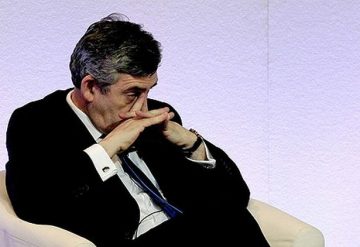
Gordon Brown broke promises on the EU when he was Prime Minister and was a disaster to the UK’s economy. He cannot be trusted.

Brown signed the Lisbon Treaty (which was almost identical to the European Constitution) on 13 December 2007. This was despite a promise in the 2005 Labour Manifesto that ‘We will put it [the Constitution] to the British people in a referendum’.

The Treaty surrendered 70 vetoes over EU law. Despite this, Brown claimed that the Treaty had not led to ‘major constitutional changes’.

The Lisbon Treaty included the dangerous Charter of Fundamental Rights, although the Government falsely claimed at the time it had an ‘opt out’. This has been used to strike down the UK’s surveillance regime. In July 2015, the Divisional Court in London annulled the Data Retention and Investigatory Powers Act 2014, for being inconsistent with the Charter of Fundamental Rights. The Home Secretary, Theresa May, had said the legislation was ‘crucial to fighting crime, protecting children, and combating terrorism’. The European Court will now decide whether the legislation is allowed after the referendum.

Gordon Brown was Chancellor when Tony Blair surrendered half of the UK rebate, despite the Government promising that ‘the rebate will remain and we will not negotiate it away. Period’. Tony Blair’s changes have now cost the UK at least £10.4 billion.

Gordon Brown is wrong to claim the EU is needed to crack down on tax avoidance. The European Court has forced us to make multi-billion tax refunds to multinationals.

Judgements of the European Court in favour of big businesses have led to massive liabilities for the taxpayer.

The OBR now forecasts that HMRC will pay out £7.3 billion from 2016-2017 to 2020-2021, an average of £270.43 per household.

If HMRC also loses every case currently pending (a further £35.6 billion), the UK will be forced to pay out £42.9 billion, the equivalent of £1,589 per household.

The UK has tried to block these payouts before but its tax legislation has been overruled by the European Court.

The Justice Secretary, Michael Gove, has proposed emergency legislation immediately after the referendum to end these payouts, stating: ‘The European Court has consistently come down in favour of big businesses not the British people – costing us billions. Very soon after a leave vote we will be able to legislate to ensure that EU judges are not able to meddle in our tax affairs again which will save British taxpayers from tens of billions of pounds worth of liabilities. I think we would all prefer it if that money is spent on schools and hospitals rather than filling the coffers of multinational corporations’.


Gordon Brown has repeatedly talked Britain down. We should not listen to him.

Last year, Gordon Brown claimed that those advocating a leave vote were supporting ‘the North Korea option, out in the cold with few friends, no influence, little new trade and even less new investment’.

During the 2010 general election campaign, Gordon Brown called lifelong Labour voter Gillian Duffy ‘bigoted’ for raising concerns about the level of immigration from Eastern Europe.


Gordon Brown did support the UK joining the single currency.

In 1997, when he was Chancellor of the Exchequer, Gordon Brown, said ‘British membership of a successful single currency would be beneficial to Britain and Europe’.

An official Treasury assessment published on the same day stated that the single currency would benefit the British economy: ‘Britain could make further gains in terms of stability from joining the single currency… The single currency could deepen competition in some parts of the Single Market. It will reduce transaction costs and exchange rate uncertainty on trade within the euro-zone. It will also make prices more transparent and easier to compare across the Single Market. It should also intensify competition. In this way it could open up new trading opportunities and encourage firms to invest in new markets…. British firms would be better placed to make the most of the opportunities if we were members of the single currency.’

GoldSaleBrown

Gordon Brown sold off Britain’s gold reserves at the bottom of the market

Between 1999 and 2002, Mr Brown ordered the sale of almost 400 tons of the gold reserves when the price was at a 20-year low. The decision to sell the gold – taken by Mr Brown when he was Chancellor – is regarded as one of the Treasury’s worst financial mistakes and has cost taxpayers almost £16 billion.

KAjwhriuw024hvjbed2SORH