

17.7 C
London
Saturday, July 11, 2026
secret satire society
Home Blog Page 496

How Micro-Aggressions Are Killing Our Students

1


Today’s students are killing themselves over micro-aggressions and becoming indoctrinated in politically correct communist doctrines that are not only bad for the brain but the libido as well.

The tragedy of outraged micro-aggressed young people today is a permanent state of anguish and revulsion to every day conversation.

Jean Spence, 23, sadly jumped off a cliff on Tuesday after a restaurant waiter accidentally addressed her as ‘Madam’. She was so outraged that in 2016 her genitals should still be an issue whilst ordering pizza that the next day she offed herself by jumping head first into the sea in Dover.

Jamila DiaRhea, 26, a student at McCartle University prided herself in being a strong black woman but was left fuming when she went into a clothes shop and a white woman asked her ‘How can I help you?’ In her journal she remarked that the white store clerk obviously thought because she was black she was naturally about to steal something. Ms DiaRhea was later found shoplifting and after becoming violent was tased to death by the police.

One student walked into a fast food store and asked where the toilets were. The worker remarked, the ‘men’s room is that way’ the incensed boy was so outraged that the worker had been gender specific, that he was later found dead in some ditch clutching a suicide note detailing the harrowing experience.

Psychoanalyst Piers Grumble, a seasoned researcher of micro-aggression theory for Humbold-Pye university, has revealed in a recent paper, the key factors that contribute to the phenomena.

“Micro-aggression is a left wing ideology first spawned in Soviet Russia during the communist era. It is utilised to control speech, to indoctrinate people into specific controlled ways of discussion, and is a politically correct technique to censor any form of right wing views, or free speech. By utilising this technique, the left can divide and control all discourse to go their way, and label any other opinion as hate speech. Already we are seeing these methods used widely on the internet, with Facebook, on Twitter and also Google which are controlled by socialists upholding pseudo-Marxist doctrines.”

So, how do we save these sad people who cannot think for themselves and are being controlled so easily by this technique that divides people further?

Fuck knows..
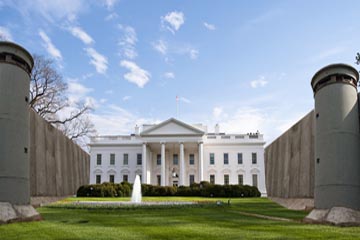
Why Are 100 Foot High Walls Being Built Around White House?

1


The wall which is funded fully by Mexico will ensure that Donald Trump or his supporters do not gain entry to the White House at all costs.

“We actually got the idea from the man himself, Donald Trump, but this time he gets the short end of the stick. As well as electoral fraud with delegates, and cancelling state election campaign votes, the wall around the White House will ensure Trump will not get a sniff at the presidential seat.

“The wall will be manned by machine gun toting Mexicans who will not hesitate to shoot Trump if he comes within 200 yards.

“We’re also installing other Trump deterrents, like Muslims who will start singing verses of the Quran through loudspeakers if they see Trump coming towards the White House.

“Politically correct social justice warriors and LGBT activists will be stationed every two yards to stop Trump by shouting highly scripted slogans and we have a battalion of well-funded Black Lives Matter operatives who will get violent at a drop of a hat, especially if there is even a sniff of a micro-aggression.

“If Trump manages to get through all that, our last line of defence is Jeb Bush. We got him and some killer turtles hanging round the corner,” Dean Albright, the senior White House aide in charge of the whole operation told CNN on Thursday.

The wall financed by Mexico will cost $4.5 billion and the Mexican president, Enrique Peña Nieto, visited the White House yesterday to see for himself how the preparations are going.


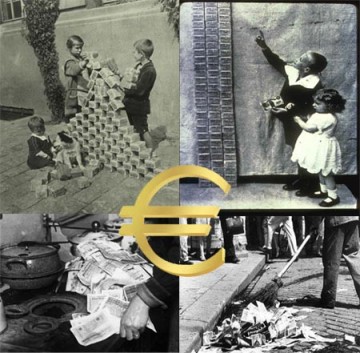
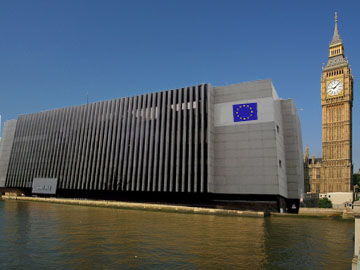
The Eurozone Risks Intensifying its Demise Why Britain Must Leave

0


What you won’t read in any Goldman Sachs funded EU propaganda and Britain Stronger in Europe (BSE) leaflets is the underlying question of fiscal sustainability of the EU in the long-term.

No amount of creative accounting can hide the vast holes in the EU budget, and sooner or later taxes across the eurozone are going to have to rise sharply to counteract this fiscal black hole.

With an ageing population requiring pensions, the eurozone is in decline population wise, the UN reveals this worrying trend in its population division analysis which shows that by 2050 the EZ will have an increase of 58% of the old age dependency ratio bringing massive costs to the eurozone.

Unfunded public sector pension liabilities across the eurozone are considerably larger than the UK, and many in the EU have little or no pension fund assets compared to the UK. If we remain in the EU, our pension wealth will be swallowed up by the eurozone pension liabilities.

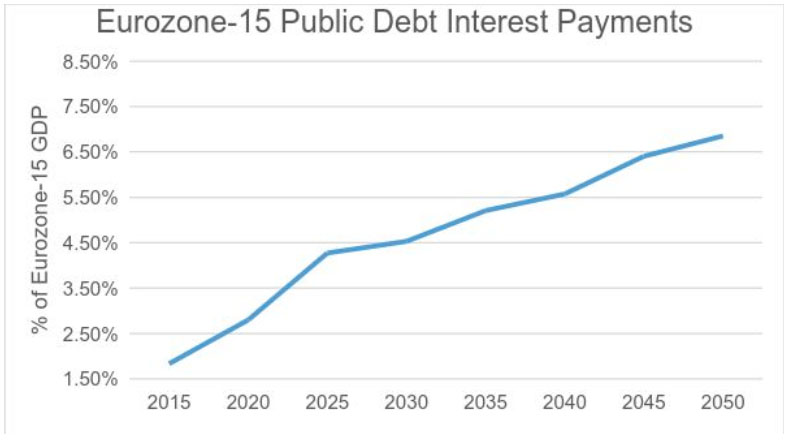
ez public debtThe eurozone also faces a time bomb of growing public debt, OECD estimates calculate that by 2050 the cost of debt interest payments will rise from 1.8% of GDP to 6.9% of GDP.

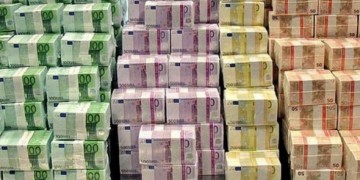
To counteract this massive shortfall the eurozone will have to raise an additional 7.1% of GDP to meet the costs, or in 2014 monetary terms, the equivalent of €726 Billion per annum. This is more than five times the current EU budget.

These are the cold hard facts that the BSE campaign to keep Britain in the EU are not telling people. They are not revealing the problems with Greece’s economy, and with Italy, or the French problem.

Greece’s debt liability alone is €355 Billion and IMF leaks reveal that the country is set to default only one month after the UK’s EU referendum.

It would thus be insanity and economical suicide for Britain to remain in such a eurozone  surfeited with huge debt, an ageing population and liabilities that compound risk to the United Kingdom.

IMF Talking Britain Down Again Resorting to Scare Tactics

0


  • The IMF has talked down the UK’s economy before – but has been consistently wrong in past forecasts about the UK and other countries.
  • There is no substantive evidence that the referendum has created uncertainty.
  • The IMF’s forecasts released today show UK growth to be robust, better than the Eurozone this year, and better than advanced economies next year.
  • The real risk to the UK economy is staying attached to the failing Eurozone, which the IMF acknowledges is ‘weak’ and a ‘concern’.
  • Many of the other IMF claims about the effect of a leave vote on sterling and trade are mistaken.
  • The EU institutions want to take the UK’s seat on the IMF. The European Parliament is calling for this today and the Commission has set out detailed plans to make this change. The safer choice is to Vote Leave.


Responding to the publication of the April 2016 ‘World Economic Outlook’ by the International Monetary Fund (IMF), Vote Leave Chief Executive Matthew Elliott said:


‘The IMF has talked down the British economy in the past and now it is doing it again at the request of our own Chancellor. It was wrong then and it is wrong now. The irony is that if we Vote Remain our voice at the IMF will be silenced as the EU wants to take our seat at the top table in return for the £350 million we hand to Brussels every week.


‘The biggest risk to the UK’s economy and security is remaining in an unreformed EU which is institutionally incapable of dealing with the challenges it faces, such as the euro and migration crises.’


The IMF has today published the ‘World Economic Outlook’ for April 2016.


The IMF has been consistently wrong about its forecasts for the UK economy. It is wrong now.


    • The IMF has tried to talk Britain’s economy down before – but its negative forecasts for the UK economy have been consistently wrong. In 2013 the IMF’s chief economist, Olivier Blanchard, warned that Britain’s growth forecasts were very low. When challenged, the Chief Economist responded: ‘I am right and they are wrong’. His estimates turned out to be inaccurate and UK growth was much stronger than he predicted.
    • The IMF later had to accept that it was wrong about its warnings for the UK. Christine Lagarde later admitted that she had ‘underestimated’ the strength of growth when the IMF assessed the UK economy in 2013.


  • Even the Head of the IN campaign has dismissed siren voices like the IMF’s. The Chairman of the IN campaign, Lord Rose of Monewden, has admitted that there are no short-term risks in voting to leave, stating: ‘Nothing is going to happen if we come out of Europe in the first five years … There will be absolutely no change … It’s not going to be a step change or somebody’s going to turn the lights out and we’re all suddenly going to find that we can’t go to France, it’s going to be a gentle process’.


There is no substantive evidence for the IMF’s claim that the referendum ‘has alreadycreated uncertainty for investors’. The IMF appears to be saying that David Cameron and George Osborne were wrong to hold a referendum.


  • The Prime Minister has said that the referendum has not caused uncertainty. In November 2014, the Prime Minister told the CBI conference that: ‘The worst thing for us to do as a country is to pretend this European debate isn’t happening … If there has been uncertainty, why is it that this has been such an extraordinary period of investment into this country?’. In 2013, he said opponents of the referendum’s ‘whole argument about there being uncertainty is fatally undermined’ and that a vote on the EU ‘is right for business, it is right for our economy’.
  • The UK has the highest growth in the G7. The OECD has forecast that the UK will be the fastest growing economy in the G7 in 2016, with growth of 2.1%.
  • There is a record number of vacancies in the UK. The ONS reports that: ‘There were 768,000 job vacancies for the 3 months to February 2016. This was: 10,000 more than for September to November 2015 [and] 26,000 more than for a year earlier’.
  • The independent Office for Budget Responsibility (OBR) has been clear there is no substantive evidence of uncertainty, despite the IMF’s claims. The IMF has claimed for months that the EU referendum would lead to uncertainty. The IMF made a high-profile intervention in February when it warned that the referendum would create uncertainty. They were completely wrong – just a few weeks later the OBR stated that ‘there were only tentative signs of uncertainty regarding the EU referendum result affecting investment intentions by the time we closed this forecast and we have made no adjustment to reflect a change in behaviour’.


The IMF’s own forecasts show UK growth to be robust, better than the Eurozone this year, and better than advanced economies next year.


  • In the IMF report (p.2), the UK is forecast to grow at 1.9% in 2016, the average rate for ‘advanced economies’. This is above the rate of growth in the Eurozone (1.5%) (p.36).
  • In 2017, the UK is forecast to grow at 2.2%, higher than average (2.0%) for ‘advanced economies’.
  • The UK’s growth prospects for 2016 have been downgraded along with every other country in the G7. This is because of global factors. As the Governor of the Bank of England has stated, these are the biggest risks to the UK economy: ‘In my judgment, the global risks, including from China, are bigger than the domestic risks’.
  • The IMF has identified ‘headwinds from fiscal consolidation’ as one of the reasons why UK growth has been downgraded. This has nothing to do with the referendum.


The European Parliament has suggested that the UK should cease to have a voice in the IMF. This will be voted on today.


  • In a report last month, the European Parliament calls for the EU to ‘seek full membership of international economic and financial institutions where this has not yet been granted and is appropriate (e.g. in the cases of the OECD and the IMF)’.
  • The report states that there should be ‘a single European Union constituency in the long term‘, with voting in the EU Council ‘moving away from consensus to a weighted majority voting system’.


The European Commission has already announced it intends to silence the UK’s voice in the IMF.

  • The EU’s blueprint for further integration and future Treaty change, the Five Presidents’ Report, calls for common EU representation ‘in the international financial institutions’ rather than letting individual member states speak for themselves. It suggests that the EU’s ‘fragmented voice means the EU is punching below its political and economic weight’ and specifically singles out the IMF as one such example.
  • In October 2015, the European Commission proposed a Council Decision to establish unified representation of the euro area in the IMF. The draft Decision, on which the UK will not have a vote, states that: ‘Close cooperation with non-euro area Member States shall be organised within the Council and the [Economic and Financial Committee], on matters related to the IMF. Common positions shall be coordinated on matters relevant for the European Union as a whole’ .

The European Court will force this through.

  • In an October 2014 decision, the European Court ruled, rejecting the UK’s arguments, that the EU may require the UK to adopt a common EU position in an international organisation of which the EU is not a member, provided that the subject matter of the decision relates to an EU legislative competence. As a result, the UK was forced to adopt an EU common position in  International Organisation of Vine and Wine.
  • Since the EU has legislative competence over financial services, the UK could be forced to adopt a common EU line in the IMF whenever the EU wants.


The real risk to the UK economy is staying attached to the failing Eurozone.


  • The IMF states that: ‘the euro area, the persistence of low inflation and its interaction with the debt overhang is also a growing concern’ (p.24).
  • The IMF notes that: ‘in the euro area, the risk of a deanchoring of inflation expectations is a concern amid large debt overhangs in several countries’ (p.xv).
  • The IMF observes that in the euro area: ‘potential growth is expected to remain weak, as a result of crisis legacies (high private and public debt, low investment, and eroding skills due to high long-term unemployment), ageing effects, and slow total factor productivity growth’ (p.18).
  • The IMF notes that: ‘with persistently high youth unemployment rates in many countries, skill erosion and its effect on trend employment are palpable concerns … The European Union also needs a more effective economic governance framework’ (p.29). This contradicts claims by the Prime Minister that the economic governance of the EU has been reformed.
  • The Governor of the Bank of England has also stated ‘we do think that there are risks of remaining in the European Union’, and that these manifested themselves ‘in particular, in relation to the development of the euro area. The Governor affirmed this statement in response to John Mann MP, stating: ‘UK membership of the European Union brings risks‘.
  • The former Governor of the Bank of England, Lord King of Lothbury, recently warned that the Eurozone ‘might explode’.


The IMF are wrong to suggest the pound is being weakened by the prospect of the referendum.


  • The pound is strengthening. There is no evidence that the increased prospect of leaving the EU is having a substantial effect on the currency or is driving movements in the foreign exchange markets. The pound has been strengthening against the US dollar over the last month from $1.3871 (26 February) to $1.4238 (12 April). The pound is much higher today (€1.2523) against the euro than it was at the time of the Bloomberg speech (€1.1506 on 1 February 2013).
  • Leaving the EU would reduce the current account deficit, and therefore ease pressure on sterling. In 2014 (the last year for which data are available) the UK recorded a £12.3 billion balance of payments deficit with the EU institutions. ONS figures released in March 2015 show the UK Government paid the EU institutions (net) £10.6 billion in 2015 (this figure excludes payments by the private sector to the EU institutions). This means we could substantially cut the current account deficit if we Vote Leave. The EU-funded Oxford Economics group has concluded that if the UK voted to leave the EU, ‘In most cases (five out of nine), the UK’s trade balance improves’.


The IMF wrongly states that ‘negotiations on post exit arrangements would likely be protracted’.


  • Greenland left the EU in less than three years with a free trade agreement (FTA) covering its major exports. Greenland voted to leave the then European Economic Community on 23 February 1982. The Treaty amending, with regard to Greenland, the Treaties establishing the European Communities was signed at Brussels on 13 March 1984. The Treaty entered into force on 1 February 1985 . This provided for the abolition of tariffs, quotas and measures equivalent to quotas on Greenland’s principal export, fish products.
  • The US-Australia FTA was concluded in less than two years: Formal negotiations for a free trade agreement began in Canberra on 18 March 2003. The agreement came into effect on 1 January 2005. The US Government states that ‘as a result of the U.S.-Australia Free Trade Agreement, tariffs that averaged 4.3 percent were eliminated on more than 99% of the tariff lines for U.S. manufactured goods exports to Australia’.
  • The Switzerland-China FTA was negotiated in just over two years: There were 9 rounds of negotiations between April 2011 and May 2013 which ‘produced a deal praised by both sides for its quality and its breadth, covering goods, services, investment, and competition. The agreement entered into force on 1 July 2014.


The IMF claims leaving the EU would ‘damag[e] a wide range of trade and investment relationships.’


  • The Prime Minister has said this is false. He has admitted: ‘If we were outside the EU altogether, we’d still be trading with all these European countries, of course we would… Of course the trading would go on. Sometimes … There’s a lot of scaremongering on all sides of this debate. Of course the trading would go on’.


  • The UK’s former Ambassador to the EU has contradicted this claim. The UK’s former Ambassador to the EU and leading supporter of BSE (Britain Stronger in Europe), Lord Kerr of Kinlochard, has admitted: ‘there is no doubt that the UK could secure a free trade agreement with the EU. That is not an issue’.
  • The CBI disagrees with it. The pro-EU CBI has said: ‘the UK is highly likely to secure a Free Trade Agreement with the EU, and such an agreement would be likely to be negotiated at an extremely high level of ambition relative to other FTAs’.
  • The Head of the IN campaign says other trade deals could continue. Trade with third countries will not be disrupted. Even the Executive Director of the BSE campaign, Will Straw, has accepted that free trade agreements with third countries could continue, stating: ‘either eventuality could come to pass’.
  • The UK would gain new trading and investment opportunities if we Vote Leave. Outside the EU’s common commercial policy, the UK could strike free trade agreements with emerging economies such as Brazil, India and China which the EU has consistently failed to negotiate. This will be good for jobs, growth and living standards.


Analysis suggests that the economy will grow if we Vote Leave.


  • In a recent report for the CBI, PwC had to admit that employment will grow if we Vote Leave. It also stated that ‘our model estimates suggest that [t]otal real UK GDP could be around 36-39% higher in 2030 than in 2015 in the two exit scenarios’. The paper also admits that growth will continue in the short term and that, in the long term, economic growth will be stronger outside the EU compared to remaining inside.


Christine Lagarde is facing serious criminal allegations. She should address these before interfering in the UK referendum.


  • Christine Lagarde has been charged with negligence by a French court over her alleged role in the payment of £293 million to a French businessman, Bernard Tapie. The French Republic has since ordered Mr Tapie to repay the money.
  • If convicted, Ms Lagarde could face up to a year’s imprisonment.

Brexit Would Not Be Political Arson Mr. David Miliband

0

“Leaving the EU would be an act of political arson that risks the destruction of international order,” the former foreign secretary David Miliband has said.

Since when has reclaiming Britain’s sovereignty, its rights to make its own laws and economic affairs and securing its borders been a risk to the international order? When we Vote Leave on June 23, there will be minimal risk to the international order as Britain will retain its ties with Europe as well as NATO and the United States. Britain will retain its seat on the UN Security Council and will still have the world’s fifth largest military budget.


“It means forsaking our position at the negotiating table and abandoning our international responsibilities – unilateral political disarmament. No nation in human peacetime history has voluntarily given up as much political power as we are being invited to throw away on 23 June.”

Absolute rubbish and falsity spouted from an out-of-touch exile. Miliband is scaremongering with false pretensions and lies. Britain would not forsake its position on any negotiating table. However, Britain in the EU is outvoted on a constant basis with little or no influence in any EU laws costing the UK £2.4 billion each year.


“The British question is not only one of what we get out of Europe. It is also one of whether we want to shore up the international order, or contribute to its dilution and perhaps even destruction,” said Miliband, who now heads the International Rescue Committee in New York.

The International Rescue Committee received €28,525,880 from the European Commission in funding in 2014 alone, so of course Miliband would say that. Shoring up the international order would increase with a Brexit, because the UK would then forge more lucrative global trade deals and still retain the EU business. The international order would be further strengthened with a strong economically viable Britain.


“Britain cannot solve these problems alone. But we do more in and for the world than our modest size would suggest. At our best, we lead in defending the values, building the structures and defining the substance of international cooperation.

“If the world is increasingly divided between firefighters and arsonists, then Britain has for centuries been a firefighter. This is no time for Britain to join the ranks of arsonists and there should be no doubt that Brexit would be an act of arson on the international order.”

Freedom to conduct ones own business is NOT arson Mr. Miliband. You are scaremongering and showing a defeatist attitude. Here is a man who had no qualms in pushing for Britain to join the euro currency in 2002, which would have been a major disaster for the country and its economy. Here is a man who signed us up to the Lisbon Treaty and misled the public about the power of the Charter of Fundamental Rights.

The world is even more divided now with the EU in existence than since World War II, who is Miliband kidding? The EU has stoked tensions in Ukraine, and the Middle East. The EU has created a passport free area for terrorists, and smuggling of high grade weaponry. Paris, Brussels, London 7/7? Securing our borders on Brexit will ensure our security, in the EU Britain has no control whatsoever of its border integrity.

Outside the EU Britain would prosper economically and even the ONS admits it. Moody’s has also refuted claims from the Project Fear camp.

We must therefore Vote to Leave on June 23, for the sake of Britain’s security, economic development and international standing.

Do not listen to defeatist scaremongering from the likes of failed politicians like David Miliband, and his equally lacklustre brother.

More facts here


Healthcare Workers Say We Should Vote Leave to Save the NHS

0


In the letter they argue that the Government has ‘starved the NHS of necessary funding‘ and that if we Vote Leave we will be able to spend more on the NHS.


The letter concludes: ‘As healthcare professionals who have worked for the NHS for years we believe that the best choice in the EU referendum is to Vote Leave on June 23rd and save the NHS.’


Thousands more NHS workers have signed up to back the Vote Leave ‘Save our NHS’ campaign, but do not want to be named publicly as they are worried about the pressure that would be put on them by the Government if they speak out.


Commenting, one of the signatories, Dr Philip Cunnington said:


Billions of pounds of UK taxpayers’ money is sent to Brussels every year while the NHS is starved of funding. Let’s Vote Leave on June 23rd and take control of our spending, allocating it to important things such as the NHS’.


Vote Leave Chair Gisela Stuart MP said:


‘The NHS is struggling to cope with rising demand. The Government has simply not given it the funding that it needs.


Instead of handing over £350 million a week to Brussels we should spend our money on our priorities like the NHS.


‘If we Vote Leave we will be able to stop our money being spent on EU bureaucrats and instead invest in the NHS so that patients can get the best possible care.


Letter text


Dear Sir,

The NHS is a great British institution that families rely on in times of need. But as it slips into financial crisis the NHS itself needs some urgent attention.


The NHS is being asked to make huge cuts at a time of rising demand. Patients are having to wait longer for treatment, hospital deficits are increasing and doctors are on strike after being told they must take a pay cut. The Government must accept responsibility for this – they have starved the NHS of necessary funding for too long.


If we Vote Leave on 23 June we will be able to spend more on our priorities like the NHS. If we put the billions that currently go to EU bureaucrats into the NHS instead it would hugely improve patient care. For example, the £350 million a week we hand to Brussels is similar to the entire yearly Cancer Drugs Fund budget.


As healthcare professionals who have worked for the NHS for years we believe that the best choice in the EU referendum is to Vote Leave on June 23rd and save the NHS.


List of signatories


Dr Abdullah Abbasi Clinical Fellow Accident and Emergency Dept Wye Valley NHS Trust
Carol Akrbi Retired senior carer
Iain Ashworth GP tutor
Dave M Bruce NHS Paramedic
Janet Bugg Practice nurse
Nigel Butterworth Paramedic Practitioner with Yorkshire Ambulance Service NHS Trust.
Andrew Cobb Consultant Orthopaedic Surgeon
Nicola Colley Midwife
Dr Philip Cunnington General Manager (IAPT), Primary Care Mental Health
Professor Angus Dalgleish Professor of Oncology
Dr Peter Dawson GP
Nisam Deen Psychiatric nurse
Giselle Devereaux Community nurse
Guy Dickinson Retired GP
John Dilks Retired Mental nurse
Geraldine Douglas Retired RGN nurse
Sarah Elliott Administrator for patient experience
Gill Fairclough Retired RGN nurse
Wendy Foster Practice Manager – NHS GP Surgery
Samantha Green A&E nurse
Joan Halton Retired community nurse
Brian Halton Retired ambulance patient transport driver.
Sarah Hardy NHS Property Manager
Mark Higginson Nurse
Nicola Hill Staff nurse
Dr Charles Holford (retired) Consultant General Surgeon MS (Lond), FRCS (Eng), MRCP (Eng)
Dr Timothy Jardine-Brown Retired GP
Robert Jeakins Ambulance Care Assistant
Dr Teck Khong GP
Michelle Knight Qualified nurse
Karen Layton Healthcare assistant
Rachelle Lewis Retired nurse
Susan Lisemore Retired ITU nurse
Dr Peter Minnis Junior Doctor
Dr William Morgan Retired GP
Dr Thomas Nixon Ophthalmology Registrar
Nicholas Palmer Ex MLA Cytology
Thakorbhai Patel Retired pharmacist
Dr Kim Peacock Retired GP
Dr David Ratliff Retired GP
Michelle Reilly Nurse
Michael Schweiger Community First Responder
Margaret Scott Retired nurse
Marsha Shack Student nurse
Dr Paul Smith Retired GP
Dr Laurel Spooner Lead Clinician
Dr Michelle Tempest Psychiatrist
Dr Merion Thomas Consultant Oncologist
Liz Troy Community psychiatric nurse
Robert Watkins Healthcare Worker offender health
Stephen Webb Operating department practitioner (ODP)
Dr Klaus Witte Associate Professor and Consultant Cardiologist
Katrina Woodrow Kinesiologist
Clive Wraight Healthcare Assistant

David Miliband On the EU: Wrong Then, Wrong Now

9

Responding to David Miliband’s expected comments in a speech on the EU referendum, Priti Patel MP said:


‘David Miliband talks of political disarmament but appears to have conveniently forgotten his leading role in the Blair Government that relentlessly surrendered national powers to the EU, gave away billions from the British rebate, campaigned to scrap the pound and failed to retain control over our borders.


‘As Foreign Secretary he signed us up to the Lisbon Treaty that sacrificed important EU vetoes and misled the public about the power of the Charter of Fundamental Rights. Voters will be in no mood for lectures from someone who was wrong then on the EU and is wrong now. The safer option in this referendum is to stop handing Brussels £350 million every week and Vote Leave on 23 June‘.


David Miliband supported UK entry into the single currency, claiming this was ‘vital’. He was wrong then and he is wrong now.


  • ‘David Miliband, the former head of Tony Blair’s policy unit who was elected to parliament last June, is to join a panel of Labour MPs who will put forward the pro-euro case at Labour party events throughout Britain’.
  • In May 2002, Miliband signed a parliamentary motion claiming that the ‘five tests’ for scrapping the pound had already been met.


David Miliband supported the ratification of the Lisbon Treaty and the transfer of more powers to the EU institutions.


  • David Miliband was Foreign Secretary at the time of Lisbon Treaty.
  • He claimed the UK had an opt out from the Charter of Fundamental Rights, stating: ‘A new legally binding protocol guarantees that nothing in the charter extends the ability of any court to strike down UK law’. The European Court has since ruled that the relevant Protocol ‘does not intend to exempt the Republic of Poland or the United Kingdom from the obligation to comply with the provisions of the Charter or to prevent a court of one of those Member States from ensuring compliance with those provisions’.
  • The European Court has used the Charter to create a right to vote in elections to the European Parliament for convicted prisoners. The law firm Leigh Day stated that ‘the European Court of Justice (ECJ) has confirmed that the UK’s blanket bans on prisoners voting in European elections is likely to be unlawful. The decision opens up the UK Government to claims for compensation by prisoners unable to vote in elections held in May 2014 and further legal action if the UK Government refuses to take action to allow prisoners to vote in the May 2019 elections’.
  • The Charter is a threat to national security. In July 2015, the Divisional Court struck down the Data Retention and Investigatory Powers Act 2014 as inconsistent with the Charter. In November 2015, the Court of Appeal referred the law to the ECJ to see whether or not it is allowed. When the Act was introduced the Home Secretary, Theresa May, stated that it was ‘crucial to fighting crime, protecting children, and combating terrorism’  The European Court will hear this case tomorrow.


David Miliband will claim that ‘the European Union multiplies British power’ and that leaving means ‘less influence’. This is false. The UK is constantly outvoted in the EU institutions.


  • On all 72 occasions that the UK has voted against a measure in the Council of Ministers, it has been outvoted. This is happening with increased frequency: of the UK’s 72 defeats, over half (40) have occurred in the last five years. This costs the British taxpayer £2.4 billion each year.
  • The UK has been defeated in over 77% of cases in which it has been a party in the European Court. Since the current Government entered office in May 2010, the UK has been defeated on 16 occasions: a failure rate of 80%.
  • The UK’s representatives are often outvoted in the European Parliament as well. The majority of UK MEPs voted against 576 EU proposals between 2009 and 2014, but 485 still passed, a failure rate of 84%.


David Miliband will claim leaving the UK will amount to an act of ‘unilateral political disarmament’. This is false.


  • If we Vote Leave, we will remain a permanent member of the UN Security Council and will still have the world’s fifth largest military budget. A vote to leave the EU is not a vote to endanger political cooperation or defence cooperation.
  • Statistics from NATO show other EU countries have consistently failed to meet their obligations to NATO, spending just 1.29% of their collective GDP on defence, far short of the 2% target met by the UK and NATO as a whole.


David Miliband will claim that leaving the EU means ‘less security’. This is false, as many experts have made clear.


  • The respected former Chief of the Secret Intelligence Service, Sir Richard Dearlove, has said: ‘the truth about Brexit from a national security perspective is that the cost to Britain would be low. Brexit would bring two potentially important security gains: the ability to dump the European Convention on Human Rights—remember the difficulty of extraditing the extremist Abu Hamza of the Finsbury Park Mosque—and, more importantly, greater control over immigration from the European Union’.
  • General Michael Hayden, the former chief of the CIA, agrees stating: ‘Sir Richard is right’ that a vote to leave the EU would have little impact on America’s willingness to work with the UK: ‘The union is not a natural contributor to national security’ and ‘gets in the way of the state providing security for its own citizens’.


  • The EU’s own Frontex Agency has admitted that the EU’s open borders policies are damaging, stating: ‘there is a risk that some persons representing a security threat to the EU may be taking advantage of this situation’ and that ‘there is clearly a risk that persons representing a security threat maybe entering the EU’.
  • Major General Julian Thompson, who commanded land forces during the Falklands War, has said ‘membership of the EU weakens our national defence in very dangerous times’.
  • Richard Walton, former Head of Counter Terrorism Command at New Scotland Yard (2011-15), has said: ‘membership of the EU does not really convey any benefits that we couldn’t access if we were outside it… Success in countering terrorism does not depend on any of us being members of a particular club. It is simply achieved through international collaboration to prevent known threats from passing across borders‘.
  • The former Secretary-General of Interpol, Ronald K Noble has said the EU ‘is effectively an international passport-free zone for terrorists to execute attacks on the Continent and make their escape’.


The EU and the European Court is weakening security.


  • The European Court has said that our Government cannot require family members of EU nationals to have a permit issued by UK authorities, but must accept permits from other EU countries. This is despite the fact that Mr Justice Haddon-Cave found that permits from other EU countries are forged on a ‘systemic’ basis. This will make it easier for terrorists to enter the UK using forged documents. The former Secretary General of Interpol, Ronald K Noble, has observed that ‘eight Schengen countries were on the list of the top 10 nations reporting stolen or lost passports in Interpol’s databases’.
  • On 4 February 2016, Advocate General Professor Maciej Szpunar issued an opinion stating that it was ‘in principle’ contrary to the Treaties to remove ‘CS’ from the UK, notwithstanding the fact that she had been convicted and sentenced to a year’s imprisonment. It was subsequently revealed under parliamentary privilege that ‘CS’ was the daughter-in-law of Abu Hamza, who was convicted of attempting to smuggle a SIM card to him in high security prison.


David Miliband will claim being in the EU is needed to ensure ‘public services can survive the flight of capital from western tax authorities’. The EU is facilitating tax avoidance.


  • Large companies have been using EU law to reclaim tax from HMRC. The OBR has forecast HMRC will pay out £7.3 billion in refunds over the next five years, enough to pay for twenty-five brand new fully-staffed hospitals. HMRC’s contingent liabilities for taxes being challenged under EU law are £35.6 billion, 105 times as much as what is spent on the Cancer Drugs Fund each year. The UK’s new 45% tax on corporate tax refunds is currently being challenged by multinational businesses under EU law, which could lead to billions of further payouts.
  • The Commission has previously accepted that ‘there are many cases where it [the Parent-Subsidiary Directive] is being abused by companies to avoid paying taxes in any Member State’.
  • This is on top of the £19.1 billion the UK sends to the EU institutions each year.


David Miliband will claim that being in the EU gives the UK ‘the power to help shape the negotiation of global trade deals’. This is false. The EU has an extremely poor track record at negotiating free trade deals.


  • The EU has been very poor at negotiating trade deals. In 2015, the aggregate GDP of all the countries with which the EU had a trade agreement in force was $7.7 trillion. By contrast, the aggregate GDP of all countries with which Chile had trade agreements was $58.3 trillion. The figure for South Korea was $40.8 trillion and that for Switzerland was $39.8 trillion (albeit these all include the EU with a GDP of $16.7 trillion).
  • The EU has failed to negotiate a free trade agreement with China. By contrast, both Iceland (which has a population of less than half a million) and Switzerland have negotiated free trade agreements with China.
  • The EU has failed to negotiate trade agreements with major emerging economies, such as India and Brazil. It is safer to take back control of trade policy.


The International Rescue Committee of which Miliband is President is funded by the EU.


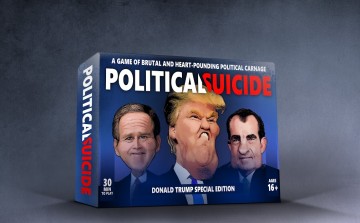
Why Committing Political Suicide Can Be Fun


The fun arises when seasoned Machiavellian politicians commit political suicide, to see them squirm as they falter is a joy to many observers, especially their political rivals.

That’s why you’ve got to play the game, aptly named ‘Political Suicide’ and see how far you can get in the tortured halls of power yourself without falling prey to some other dastardly vicious rival.

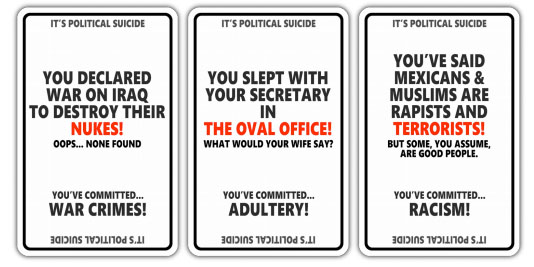
political suicide cards

In the game, players must fight to prevent their own suicide whilst bringing down their political opponents.

This amazing card game will have you and your friends turn into stone cold backstabbers in no time, but it’s all good natured fun folks because it’s just the game of politics, we’re all friends here, is that right Mr. Trump?

Now you want to play, you have to support the Political Suicide team get this game on the podium with their Kickstarter campaign.


Secret EU Plan to Control and Reduce UK Pensions & Benefits Uncovered

0

It’s not only UK pensions on the chopping block but Britain’s whole welfare system when the ESF takes it over.

David Cameron’s paltry EU concessions do not take into account the European Social Fund and its plans to bully member states to take control of their welfare, pensions and health budgets.

This would involve a vast reduction in funding for Britain’s NHS and social care system, reducing unemployment and tax credits for working families as well as UK pensions; this horrific news comes especially as millions of migrants are pouring into EU every year leaving less money in the pot for everyone.

Thyssen’s reasoning in bringing Britain in line with the rest of the EU social welfare system, will mean the generous benefits received by many in the UK will be collectively brought within the same levels across the EU as a one-size-fits-all system. The migrant crisis needs a lot of funding for housing and education of first tier migrants, and there will have to be a redirection of funds used in the UK to those migrants who need the most help.

 EU Britain

It is interesting that many who wish to remain in the EU are wilfully supporting their own socialist demise, where vulnerable British families within the UK’s welfare system will suffer the most.

Generous UK benefits is why there are so many illegal migrants in Calais waiting to come over to Britain, and the EU ‘social fund’ will put an end to that because UK benefits will be as mediocre as the ones across the whole of the EU.

If you want to protect Britain’s health care system and its social welfare system and pensions it is imperative that you vote to leave the EU on June 23, or Britain will not have any control of pensions, welfare or health budgets.

Vote Leave FACTS: Big Businesses Use EU Law to Claim Billions From the Taxpayer

0

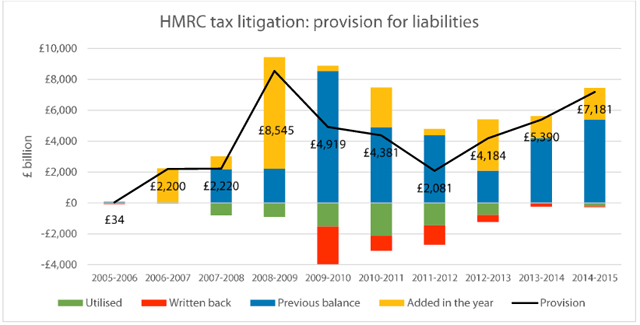
The money set aside by HMRC to settle litigation concerning taxes subject to challenge has increased from £34 million in 2005-2006 to £7.2 billion in 2015-2016, with HMRC paying out £7.87 billion between 2005-2006 and 2014-2015.

The OBR forecasts suggests HMRC will pay out £7.3 billion between 2016-2017 and 2020-2021, which is enough to pay for twenty five brand new fully staffed NHS hospitals, two further Queen Elizabeth class aircraft carriers, and more than what will be spent on road maintenance in England in the same period.

The new 45% rate of corporation tax on compound interest payable to large companies on taxes levied in breach of EU law is subject to five separate challenges under EU law, raising the prospect that HMRC will have to make further expensive refunds.

Big business is taking British taxpayers to court in Europe where unelected judges are overruling the decisions of our parliament on tax rules – costing us all billions.

obr chart litigation 2015Source: HMRC; OBR, July 2015


KAjwhriuw024hvjbed2SORH