17.7 C
London
Saturday, January 10, 2026
secret satire society
Home Blog Page 476

David Miliband On the EU: Wrong Then, Wrong Now

9

Responding to David Miliband’s expected comments in a speech on the EU referendum, Priti Patel MP said:


‘David Miliband talks of political disarmament but appears to have conveniently forgotten his leading role in the Blair Government that relentlessly surrendered national powers to the EU, gave away billions from the British rebate, campaigned to scrap the pound and failed to retain control over our borders.


‘As Foreign Secretary he signed us up to the Lisbon Treaty that sacrificed important EU vetoes and misled the public about the power of the Charter of Fundamental Rights. Voters will be in no mood for lectures from someone who was wrong then on the EU and is wrong now. The safer option in this referendum is to stop handing Brussels £350 million every week and Vote Leave on 23 June‘.


David Miliband supported UK entry into the single currency, claiming this was ‘vital’. He was wrong then and he is wrong now.


  • ‘David Miliband, the former head of Tony Blair’s policy unit who was elected to parliament last June, is to join a panel of Labour MPs who will put forward the pro-euro case at Labour party events throughout Britain’.
  • In May 2002, Miliband signed a parliamentary motion claiming that the ‘five tests’ for scrapping the pound had already been met.


David Miliband supported the ratification of the Lisbon Treaty and the transfer of more powers to the EU institutions.


  • David Miliband was Foreign Secretary at the time of Lisbon Treaty.
  • He claimed the UK had an opt out from the Charter of Fundamental Rights, stating: ‘A new legally binding protocol guarantees that nothing in the charter extends the ability of any court to strike down UK law’. The European Court has since ruled that the relevant Protocol ‘does not intend to exempt the Republic of Poland or the United Kingdom from the obligation to comply with the provisions of the Charter or to prevent a court of one of those Member States from ensuring compliance with those provisions’.
  • The European Court has used the Charter to create a right to vote in elections to the European Parliament for convicted prisoners. The law firm Leigh Day stated that ‘the European Court of Justice (ECJ) has confirmed that the UK’s blanket bans on prisoners voting in European elections is likely to be unlawful. The decision opens up the UK Government to claims for compensation by prisoners unable to vote in elections held in May 2014 and further legal action if the UK Government refuses to take action to allow prisoners to vote in the May 2019 elections’.
  • The Charter is a threat to national security. In July 2015, the Divisional Court struck down the Data Retention and Investigatory Powers Act 2014 as inconsistent with the Charter. In November 2015, the Court of Appeal referred the law to the ECJ to see whether or not it is allowed. When the Act was introduced the Home Secretary, Theresa May, stated that it was ‘crucial to fighting crime, protecting children, and combating terrorism’  The European Court will hear this case tomorrow.


David Miliband will claim that ‘the European Union multiplies British power’ and that leaving means ‘less influence’. This is false. The UK is constantly outvoted in the EU institutions.


  • On all 72 occasions that the UK has voted against a measure in the Council of Ministers, it has been outvoted. This is happening with increased frequency: of the UK’s 72 defeats, over half (40) have occurred in the last five years. This costs the British taxpayer £2.4 billion each year.
  • The UK has been defeated in over 77% of cases in which it has been a party in the European Court. Since the current Government entered office in May 2010, the UK has been defeated on 16 occasions: a failure rate of 80%.
  • The UK’s representatives are often outvoted in the European Parliament as well. The majority of UK MEPs voted against 576 EU proposals between 2009 and 2014, but 485 still passed, a failure rate of 84%.


David Miliband will claim leaving the UK will amount to an act of ‘unilateral political disarmament’. This is false.


  • If we Vote Leave, we will remain a permanent member of the UN Security Council and will still have the world’s fifth largest military budget. A vote to leave the EU is not a vote to endanger political cooperation or defence cooperation.
  • Statistics from NATO show other EU countries have consistently failed to meet their obligations to NATO, spending just 1.29% of their collective GDP on defence, far short of the 2% target met by the UK and NATO as a whole.


David Miliband will claim that leaving the EU means ‘less security’. This is false, as many experts have made clear.


  • The respected former Chief of the Secret Intelligence Service, Sir Richard Dearlove, has said: ‘the truth about Brexit from a national security perspective is that the cost to Britain would be low. Brexit would bring two potentially important security gains: the ability to dump the European Convention on Human Rights—remember the difficulty of extraditing the extremist Abu Hamza of the Finsbury Park Mosque—and, more importantly, greater control over immigration from the European Union’.
  • General Michael Hayden, the former chief of the CIA, agrees stating: ‘Sir Richard is right’ that a vote to leave the EU would have little impact on America’s willingness to work with the UK: ‘The union is not a natural contributor to national security’ and ‘gets in the way of the state providing security for its own citizens’.


  • The EU’s own Frontex Agency has admitted that the EU’s open borders policies are damaging, stating: ‘there is a risk that some persons representing a security threat to the EU may be taking advantage of this situation’ and that ‘there is clearly a risk that persons representing a security threat maybe entering the EU’.
  • Major General Julian Thompson, who commanded land forces during the Falklands War, has said ‘membership of the EU weakens our national defence in very dangerous times’.
  • Richard Walton, former Head of Counter Terrorism Command at New Scotland Yard (2011-15), has said: ‘membership of the EU does not really convey any benefits that we couldn’t access if we were outside it… Success in countering terrorism does not depend on any of us being members of a particular club. It is simply achieved through international collaboration to prevent known threats from passing across borders‘.
  • The former Secretary-General of Interpol, Ronald K Noble has said the EU ‘is effectively an international passport-free zone for terrorists to execute attacks on the Continent and make their escape’.


The EU and the European Court is weakening security.


  • The European Court has said that our Government cannot require family members of EU nationals to have a permit issued by UK authorities, but must accept permits from other EU countries. This is despite the fact that Mr Justice Haddon-Cave found that permits from other EU countries are forged on a ‘systemic’ basis. This will make it easier for terrorists to enter the UK using forged documents. The former Secretary General of Interpol, Ronald K Noble, has observed that ‘eight Schengen countries were on the list of the top 10 nations reporting stolen or lost passports in Interpol’s databases’.
  • On 4 February 2016, Advocate General Professor Maciej Szpunar issued an opinion stating that it was ‘in principle’ contrary to the Treaties to remove ‘CS’ from the UK, notwithstanding the fact that she had been convicted and sentenced to a year’s imprisonment. It was subsequently revealed under parliamentary privilege that ‘CS’ was the daughter-in-law of Abu Hamza, who was convicted of attempting to smuggle a SIM card to him in high security prison.


David Miliband will claim being in the EU is needed to ensure ‘public services can survive the flight of capital from western tax authorities’. The EU is facilitating tax avoidance.


  • Large companies have been using EU law to reclaim tax from HMRC. The OBR has forecast HMRC will pay out £7.3 billion in refunds over the next five years, enough to pay for twenty-five brand new fully-staffed hospitals. HMRC’s contingent liabilities for taxes being challenged under EU law are £35.6 billion, 105 times as much as what is spent on the Cancer Drugs Fund each year. The UK’s new 45% tax on corporate tax refunds is currently being challenged by multinational businesses under EU law, which could lead to billions of further payouts.
  • The Commission has previously accepted that ‘there are many cases where it [the Parent-Subsidiary Directive] is being abused by companies to avoid paying taxes in any Member State’.
  • This is on top of the £19.1 billion the UK sends to the EU institutions each year.


David Miliband will claim that being in the EU gives the UK ‘the power to help shape the negotiation of global trade deals’. This is false. The EU has an extremely poor track record at negotiating free trade deals.


  • The EU has been very poor at negotiating trade deals. In 2015, the aggregate GDP of all the countries with which the EU had a trade agreement in force was $7.7 trillion. By contrast, the aggregate GDP of all countries with which Chile had trade agreements was $58.3 trillion. The figure for South Korea was $40.8 trillion and that for Switzerland was $39.8 trillion (albeit these all include the EU with a GDP of $16.7 trillion).
  • The EU has failed to negotiate a free trade agreement with China. By contrast, both Iceland (which has a population of less than half a million) and Switzerland have negotiated free trade agreements with China.
  • The EU has failed to negotiate trade agreements with major emerging economies, such as India and Brazil. It is safer to take back control of trade policy.


The International Rescue Committee of which Miliband is President is funded by the EU.


Why Committing Political Suicide Can Be Fun

1


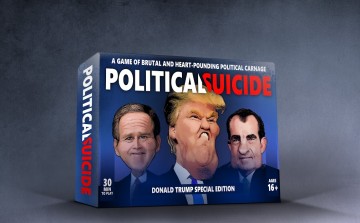
The fun arises when seasoned Machiavellian politicians commit political suicide, to see them squirm as they falter is a joy to many observers, especially their political rivals.

That’s why you’ve got to play the game, aptly named ‘Political Suicide’ and see how far you can get in the tortured halls of power yourself without falling prey to some other dastardly vicious rival.

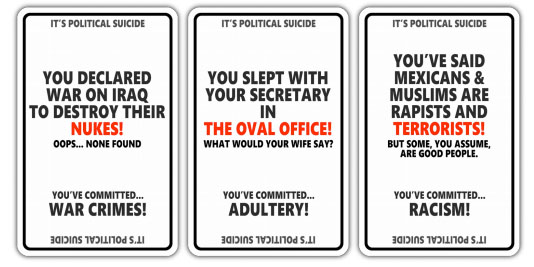
political suicide cards

In the game, players must fight to prevent their own suicide whilst bringing down their political opponents.

This amazing card game will have you and your friends turn into stone cold backstabbers in no time, but it’s all good natured fun folks because it’s just the game of politics, we’re all friends here, is that right Mr. Trump?

Now you want to play, you have to support the Political Suicide team get this game on the podium with their Kickstarter campaign.


Secret EU Plan to Control and Reduce UK Pensions & Benefits Uncovered

0

It’s not only UK pensions on the chopping block but Britain’s whole welfare system when the ESF takes it over.

David Cameron’s paltry EU concessions do not take into account the European Social Fund and its plans to bully member states to take control of their welfare, pensions and health budgets.

This would involve a vast reduction in funding for Britain’s NHS and social care system, reducing unemployment and tax credits for working families as well as UK pensions; this horrific news comes especially as millions of migrants are pouring into EU every year leaving less money in the pot for everyone.

Thyssen’s reasoning in bringing Britain in line with the rest of the EU social welfare system, will mean the generous benefits received by many in the UK will be collectively brought within the same levels across the EU as a one-size-fits-all system. The migrant crisis needs a lot of funding for housing and education of first tier migrants, and there will have to be a redirection of funds used in the UK to those migrants who need the most help.

 EU Britain

It is interesting that many who wish to remain in the EU are wilfully supporting their own socialist demise, where vulnerable British families within the UK’s welfare system will suffer the most.

Generous UK benefits is why there are so many illegal migrants in Calais waiting to come over to Britain, and the EU ‘social fund’ will put an end to that because UK benefits will be as mediocre as the ones across the whole of the EU.

If you want to protect Britain’s health care system and its social welfare system and pensions it is imperative that you vote to leave the EU on June 23, or Britain will not have any control of pensions, welfare or health budgets.

Vote Leave FACTS: Big Businesses Use EU Law to Claim Billions From the Taxpayer

0

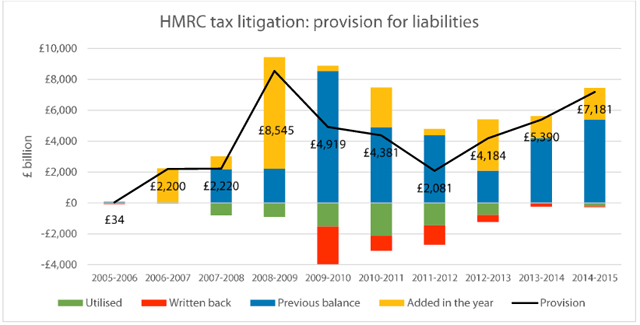
The money set aside by HMRC to settle litigation concerning taxes subject to challenge has increased from £34 million in 2005-2006 to £7.2 billion in 2015-2016, with HMRC paying out £7.87 billion between 2005-2006 and 2014-2015.

The OBR forecasts suggests HMRC will pay out £7.3 billion between 2016-2017 and 2020-2021, which is enough to pay for twenty five brand new fully staffed NHS hospitals, two further Queen Elizabeth class aircraft carriers, and more than what will be spent on road maintenance in England in the same period.

The new 45% rate of corporation tax on compound interest payable to large companies on taxes levied in breach of EU law is subject to five separate challenges under EU law, raising the prospect that HMRC will have to make further expensive refunds.

Big business is taking British taxpayers to court in Europe where unelected judges are overruling the decisions of our parliament on tax rules – costing us all billions.

obr chart litigation 2015Source: HMRC; OBR, July 2015


Why Offshore Tax Evasion is Not Really That Bad a Thing

0


People are too harsh on the likes of David Cameron, it is a sort of envy of the rich which is usually dispensed by the leftie socialist finger pointers of the world. Would Tony Blair do such things? No, he is clean as a hang man’s noose at Saddam’s hanging.

It is quite justifiable that the rich avoid seeing their money disappear forever, especially as they have worked so hard through any means to acquire their status in life. The pain one must feel, if you earn £2 million a year, to see over £1 million snatched so horribly away by the tax man. Just think how it feels, what you could have bought with that money, instead it is put into the welfare system or given to some family from Scunthorpe with 28 kids and a coterie of taxpayer funded pets, worse still, it could be eaten up by some BBC budget for a show that no one will watch less fucking care about.

What is it with Britons especially when it comes to rich people? Don’t the poor want to be rich as well one day? Is there no aspiration to rise up above the poverty level of a die hard socialist in permanent austerity? According to British socialists, there is none, but for champagne socialist politicians and celebrities, richness is something they enjoy but are thoroughly ashamed of. Britain must really learn to aspire to rise up above this sort of chastisement of the rich, where in places like America, being rich is the only aspiration that matters and is greeted with thorough adulation by the masses.

If you’re really, really rich. What happens at the end of your life? That’s worse still. You’ve got Billions in the bank that you’ve stashed away all over, and you’ll never see it again when you pop your clogs. The pain of this deathly fact must be too much to bear for some, a burden that they maybe take across the ether with them when they finally depart from this mortal coil.

Jean Claude Juncker Projectile Vomits On Reporters

0


Reuters camera man Jens Pillank, captured the spectacular show on Friday and has even been nominated for this year’s prestigious press photo award.

“I captured the moment of explosive vomitage. Juncker did not seem steady on his feet, and swayed with every step. When he stopped walking suddenly we knew something was up. And then like a magnificent waterfall it exploded, I estimate reaching over seven metres. The smell was of cognac, fresh from the distillery of Juncker’s gastric tract, of course mixed in with little bits of Haute cuisine, maybe some Magret de Canard avec Foie de Veau à la Lyonnaise. In fact, the seasoned ingredients of the vomit were quite delightful and not unpleasant at all.”

A senior aide to the EU president later apologised for the incident and revealed it could have been Brexit jitters that Mr. Juncker was suffering from.

EU Frontex Report Shows Major Flaws in European Security

0

Fostering the free movement of people has been an important objective of European integration since the 1950s. Free movement of goods, persons, services and capital were identified as foundations of the Community in the Treaty of Rome, however the Schengen zone only works in peace time, and now the globe is on the verge of war, emanating from the Middle East.

When the Frontex published its risk analysis in 2016, it admitted that the EU and its free movement laws are a major danger to security and peace.

The damning report reveals that the UK is at serious risk within the EU, and is vulnerable to inconsistencies within the EU structure and policy shifts from Brussels.

This year alone, the number of people aiming to get to the UK with fraudulent documents significantly increased (+70%) compared to 2014. This trend is mostly attributable to the increasing number of Albanian nationals often misusing Italian and Greek ID cards followed by Ukrainian nationals abusing authentic Polish ID cards.

The port of Calais is a much contentious issue, and will be for some time. The port has recorded many instances of violence, boarding of vehicles by illegal migrants and of general chaos. This is a highly unacceptable stance to have directly on the borders of the UK, and the EU is in its nonchalance creating a dangerous bottle neck of trouble within the continent.

The EU has created a passport free area for terrorists, and smuggling of high grade weaponry.

To compound the issue, there is no EU system capable of tracing people’s movements following an illegal border-crossing.

Europe has never seen such movements of people since World War II, but it seems to be caught in the headlights, standing back and just watching. Can the EU be entrusted in keeping its citizens safe? No, is the emphatic answer, especially when in 2015 there were 1.8 million illegal migrants crossing into the Schengen zone leading up to the Paris attacks.

With all these millions of people crossing the EU borders each year, they have no way of ascertaining whether the passports presented are real or forged, or to where these migrants came from.

Visa liberalisation has created serious problems and member states cannot cope with the sheer volume of migrant traffic.

The ongoing problem is all part of the EU’s dangerous flirtation with a borderless Europe, which can only work in a time of global peace, of which we have none at the moment.

This is why the UK must vote to leave on June 23, if it values its security and borders.

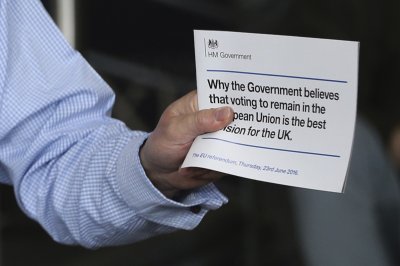
False Claims in £9 Million Taxpayer Funded Gov Leaflet Uncovered


Commenting, Vote Leave Chair Gisela Stuart MP said:


“This is not the facts, it is a misleading government propaganda campaign paid for by hard-working taxpayers who would rather see their money spent on their priorities. The public want an honest debate conducted by two competing sides, not an attempt by the Prime Minister to buy the referendum result with the public’s money. We already hand Brussels £350 million a week without having to pay more just to bail out David Cameron’s failed renegotiation and the floundering remain campaign.”

The Government’s £9.3 million document is propaganda and contains a number of false claims.

Thanks to those who signed the petition  to STOP CAMERON spending British taxpayers’ money on Pro-EU Referendum leaflets, which has now surpassed 100,000 signatures by quite a margin.
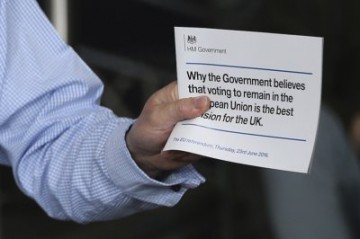
pro-eu-leaflet propaganda

False Claim 1: ‘The UK has secured a special status in a reformed EU’.


  • Despite the Government’s claims to have secured a ‘special status’ in the EU, this term is nowhere used in the Decision of the Heads of Government.
  • It does not bind the European Court, which will continue to treat the UK as it treats every other member state. In 1979, it stated that ‘the equality of Member States before Community law’ was ‘at the very root of the Community legal order‘.
  • The EU is fundamentally unchanged. Even if promised changes to the Treaties were made (and there is no guarantee of this), the Treaties would remain 99% the same as they were before the renegotiation.


False Claim 2: ‘We will keep our own border controls’.


  • Every EU citizen will retain the right to enter the UK, including serious criminals.
  • The European Court is undermining what limited checks we can still carry out. In December 2014, it decided that the UK could not require third country nationals who are married to EU citizens to obtain a permit from UK authorities to be able to enter the UK. The British Government is instead obliged in principle to accept as valid permits issued by other EU countries. This is despite the fact that Mr Justice Haddon-Cave had found that forgery of such permits was ‘systemic’. This decision makes it easier for terrorists and criminals to enter the UK using forged documents.
  • EU law also prohibits the UK from automatically denying EU citizens who lack travel documents entry into the UK, and forbids the UK from checking on a systematic basis whether EU citizens are lawfully resident in the UK. EU law requires the UK to admit EU citizens who can produce an EU passport. Yet we have no control over the way other EU countries issue their passports. Some EU member states even sell passports to the highest bidder.


False Claim 3: ‘The UK will not be part of further political integration.’


  • Such claims have been made time and time again by successive British Governments. On every occasion, they have been proven to be false.
  • In 1971, the Heath Government claimed that ‘there is no question of any erosion of essential national sovereignty‘.
  • The Wilson Government claimed in 1975 that the UK’s sovereignty would not be compromised because ‘it is the Council of Ministers, and not the market’s officials, who take the important decisions. These decisions can be taken only if all the members of the Council agree’.
  • John Major even claimed that British sovereignty had been enhanced by the Maastricht Treaty, asserting that ‘the very centralising tendency that many are so worried about was addressed and corrected at Maastricht’.


False Claim 4: ‘there will be tough new restrictions on access to our welfare system for new EU migrants’.


  • The Government admitted after the European Council that these proposals may never come into force, stating: ‘Details of the proposals for restricting in-work benefits for EU nationals will be subject to further negotiation and we cannot speculate on these’.
  • The 2015 Conservative Manifesto stated ‘We will insist that EU migrants who want to claim tax credits and child benefit must live here and contribute to our country for a minimum of four years’. This promise has been broken. The denial of ‘non-contributory in-work benefits’ will ‘be graduated, from an initial complete exclusion but gradually increasing access to such benefits to take account of the growing connection of the worker with the labour market of the host Member State.’ This makes clear EU migrants will be able to claim in-work benefits during their first four years in the UK.
  • Even if these proposals do come into force, they are far short of what the Prime Minister promised. The OBR has said they will have ‘not much’ impact on migration.
  • The emergency brake can only be invoked ‘during a period of 7 years’. This means that the UK will not be able to use the emergency break after 2023. The emergency brake can only be invoked ‘on a proposal from the Commission’ by the EU Council. The Decision states that ‘the Council could authorise’ the brake, not that it will. The UK has no right to activate the emergency brake by itself.
  • In November 2014, the Prime Minister rightly dismissed ‘some arcane mechanism within the EU, which would probably be triggered by the European Commission and not by us… some sort of EU led, EU determined brake, which would be determined and applied probably by the European Commission, I don’t actually think that would be effective’.
  • Since child benefit, unlike certain tax credits, is not a ‘non-contributory in-work benefit’, it would appear the emergency brake will not apply to it, contrary to the Conservative Manifesto.


False Claim 5: ‘The EU is by far the UK’s biggest trading partner. EU countries buy 44% of everything we sell abroad’.


  • You do not have to be part of the EU to trade with the EU. As the Prime Minister has accepted: ‘If we were outside the EU altogether, we’d still be trading with all these European countries, of course we would… Of course the trading would go on. Sometimes … There’s a lot of scaremongering on all sides of this debate. Of course the trading would go on’ (The Andrew Marr Show, 6 January 2013,).
  • The UK’s trade with the EU has been in decline over the last decade. It is down from 52% in 2005.
  • Switzerland sells more to the EU as a proportion of its exports than we do, but is not part of the EU.


False Claim 6: ‘By contrast, leaving creates uncertainty and risk.’


  • Even the Head of the IN campaign has admitted this claim is false. Lord Rose of Monewden has said that ‘nothing is going to happen if we come out of Europe… It’s not going to be a step change or somebody’s going to turn the lights out and we’re all suddenly going to find that we can’t go to France, it’s going to be a gentle process’.


False Claim 7: The Government cites industries it claims would be affected by a leave vote. In each sector, it is in the EU’s interests to maintain access to the UK’s markets or in the UK’s interests to escape from EU red tape.


  • Aerospace’. The vast majority of British exports of aerospace are sold to countries outside the EU. The ONS notes: ‘In 2013, non-EU exports accounted for around 74% of total aerospace exports, with EU exports making up the remaining 26%’.
  • ‘Chemicals and pharmaceuticals’. In 2014, the EU sold the UK £11.0 billion more in chemicals than the EU sold to the UK. In the same year, the EU sold the UK £4.7 billion more in medicinal and pharmaceutical products than the UK sold to the EU.
  • ‘Financial services’. The Head of the IN campaign has admitted that: ‘We are very good at what we do in terms of financial services. They cannot do without us‘. According to the Bank of England, in February 2015, 75 banks located in the European Economic Area ‘passported’ their services into the UK, including ABN AMRO, BNP Paribas, Deutsche Bank and Société Générale . According to the Bank of England, over 800 insurance firms in the EEA could passport their services into the UK as of September 2015. There is no prospect of EU firms choosing to cut off their access to the world’s greatest financial centre. Deutsche Bank alone employs 8,000 people in the UK and has chosen ‘to base its largest investment banking operations in the City of London, a centre of global flows of trade and wealth’.
  • ‘Food manufacturing’. In 2014, the EU sold the UK £14.6 billion more in food and live animals than the UK sold to EU.
  • ‘IT and telecoms’. In 2014, the EU sold the UK £4.5 billion more in food and live animals than the UK sold to EU.
  • ‘Transport’. In 2014, the EU sold the UK £46.5 billion more in machinery and transport equipment than the UK sold to the EU.


False Claim 8: ‘The Single Market makes it easier and cheaper for UK companies to sell their products outside the UK, creating jobs as a result.’


  • It is widely accepted that the costs of the ‘single market’ outweigh the benefits. As the UK Government admitted in 2005, the ‘single market’ ‘could cost Europe’s consumers up to 7 per cent of EU GDP’. In 2004, the incoming European Commissioner for Trade, Peter Mandelson, admitted that the cost of EU regulation was as high as 4% of GDP, twice the estimated benefits of the ‘single market’.
  • The European Commission claims (in a document which says the single currency has boosted GDP by 3.6%) that the single market has raised GDP by 2.13%, without making any attempt to quantify the costs.
  • Just 6% of British businesses export to the EU.. Nonetheless, 100% of British business must comply with EU law.
  • EU legislation costs British businesses at least £33.3 billion per year, over £600 million per week.
  • There is no evidence that the single market has been of macro-economic benefit. Countries outside the ‘single market’ have seen their exports to countries in the EU rise faster than those within the ‘single market’. As the pro-EU commentator Wolfgang Münchau has noted, ‘The single market had no discernible impact on aggregate productivity’.


False Claim 9: Being inside the EU also makes it more attractive for companies to invest in the UK, meaning more jobs. Over the last decade, foreign companies have invested £540 billion in the UK, equivalent to £148 million every day.’


  • This is extremely misleading. The Government counts every single pound invested into the UK over the last decade from every country, regardless of whether the country is in the EU or not. It is ridiculous to link all investment into the UK to the UK’s membership of the EU.
  • The Head of the IN campaign has admitted this argument is ‘all a red herring and it is just scaremongering’, stating: ‘The reason that people want to come to this country is because we have a flexible workforce, because we have stability, because we’ve got a growing economy, because we’ve got strong IPR, because this is a place to do business. I think it’s ridiculous to suggest that everybody is going to suddenly go offshore, I don’t believe that for one moment and to make sure that that doesn’t happen we have to ensure that we continue to have the right environment, an environment which is invested in, i.e. let’s invest in infrastructure. To make sure that we’ve got the right tax regime, to make sure that corporation tax is attractive to people who invest here. To make sure that we invest in the right number of people so that we’ve got these apprenticeships, we’ve got these people who are fit and ready to come into the workforce, that will dictate whether people want to have their businesses domiciled here so I think this is all a red herring and it is just scaremongering’.


False Claim 10: ‘Over 3 million UK jobs are linked to exports to the EU’.


  • The Government deliberately conflates trade with countries in the EU with EU membership. It is not necessary to be part of a political union to trade freely with the EU. Many countries around the world have free trade agreements with the EU without accepting the supremacy of EU law or paying billions to the EU. We will strike a free trade deal.
  • The Executive Director of the IN Campaign, Will Straw, has admitted: ‘We have not and have never claimed that 3 million jobs would be lost if we left the EU‘.
  • The Prime Minister, David Cameron, has accepted trade would continue, meaning jobs would not be put at risk. He said: ‘If we were outside the EU altogether, we’d still be trading with all these European countries, of course we would … Of course the trading would go on … There’s a lot of scaremongering on all sides of this debate. Of course the trading would go on’.
  • The ‘3 million jobs’ figure was invented by the pro-euro campaign group, Britain in Europe, in 2000, as part of their attempts to scrap the pound. The economist whose work they traduced, Dr Martin Weale, has dismissed the figure as ‘pure Goebbels‘, stating that ‘in many years of academic research, I cannot recall such a wilful distortion of the facts’.


False Claim 11: ‘If the UK voted to leave the EU the resulting economic shock would risk higher prices of some household goods’.


  • The Governor of the Bank of England, Dr Mark Carney, refused to agree with the claim that leaving would lead to an economic shock, despite being asked his view several times during a recent Treasury Committee hearing.
  • The Governor confirmed that: ‘the global risks, including from China are bigger than the domestic risk‘.
  • The pro-EU CBI released a report that states ‘our model estimates suggest that total real UK GDP could be around 36-39% higher in 2030 than in 2015 in the two exit scenarios’. The paper also admits that growth will continue in the short term and that, in the long term, economic growth will be stronger outside the EU compared to remaining inside.
  • The independent House of Commons Library has concluded that EU membership actually increases the costs of consumer goods, stating that the EU’s Common Agricultural Policy ‘artificially inflates food prices‘ and that ‘consumer prices across a range of other goods imported from outside the EU are raised as a result of the common external tariff and non-tariff barriers to trade imposed by the EU. These include footwear (a 17% tariff), bicycles (15% tariff) and a range of clothing (12% tariff).


False Claim 12: There would be ‘pressure’ on the value of the pound.


  • The UK recorded a current account deficit of £96.3 billion in 2015. This could be substantial reduced if we Vote Leave. In 2014 (the last year for which data are available), the UK recorded a £12.3 billion balance of payments deficit with the EU institutions. This means we could substantially cut the current account deficit if we Vote Leave.
  • The EU-funded Oxford Economics group has concluded that if the UK voted to leave the EU, ‘In most cases… the UK’s trade balance improves’.
  • There is no evidence that the increased prospect of a leave vote is having a substantial effect on the currency or is driving movements in the foreign exchange markets. The pound has been strengthening against the US dollar over the last month from $1.3871 on 26 February to $1.4013 on 6 April. This is despite the fact that the polls have shown a consistent improvement in the leave campaign’s position.


False Claim 13: ‘A vote to leave could mean a decade or more of uncertainty.’


  • The US-Australia Free Trade Agreement was concluded in less than two years. Formal negotiations for a free trade agreement began in Canberra on 18 March 2003. The agreement came into effect on 1 January 2005. The US Government states that: ‘as a result of the U.S.-Australia Free Trade Agreement, tariffs that averaged 4.3 percent were eliminated on more than 99% of the tariff lines for U.S. manufactured goods exports to Australia’.


False Claim 14: ‘From next year, mobile phone roaming charges will be abolished across the EU, saving UK customers up to 38p per minute on calls.’


  • The Minister of State for Culture and the Digital Economy, Ed Vaizey MP (who supports the IN campaign) has admitted that market access in telecommunications would continue if we Vote Leave. He has said that if ‘we were to withdraw from the European Union, I still think that British consumers would benefit. It is dangerous for any government Minister to comment on what may or may not impact on people’s views when they vote in this referendum. As we experienced with the Scottish referendum, it may be that everything, including the kitchen sink, is thrown into the argument and that roaming charges become part of that debate, but my instinct is that, should the British public decide to leave the European Union, that will not impact on their roaming ability in Europe’.


False Claim 15: ‘Canada’s deal with the EU will give limited access for services’.


  • The Government has already admitted that: ‘The EU will open its market in services significantly for Canadian firms’.
  • The Canadian Government states that: ‘CETA covers all aspects of our broad trading relationship with the EU, including goods, services, investment, government procurement and regulatory cooperation’.
  • The deal includes services, financial services, mutual recognition of qualifications and procurement.


False Claim 16: ‘Our EU membership magnifies the UK’s ability to get its way on the issues we care about.’


  • The UK has been outvoted every time it has voted against an EU measure – 72 times in total. 40 of these defeats have taken place since David Cameron became Prime Minister. This costs the UK taxpayer £2.4 billion a year. We do not get our way on the issues we care about.
  • Since the UK joined the EU in 1973, it has lost 101 out of 131 cases before the European Court, a failure rate of 77.1%. Since David Cameron became Prime Minister in May 2010, the UK has been defeated on 16 occasions: a failure rate of 80%.
  • EU rules mean that we don’t have the power to intervene to get our way at home. The Government has acknowledged that its scope to intervene in the steel crisis is limited by EU state aid rules. The Business Minister, Anna Soubry MP, has said ‘We have to be very careful because we have to be compliant with state aid rules.


False Claim 17: ‘EU cooperation makes it easier to keep criminals and terrorists out of the UK.’


  • The EU’s own Frontex Agency has recently concluded the EU makes us less safe. Frontex has said that: ‘The Paris attacks in November 2015 clearly demonstrated that irregular migratory flows could be used by terrorists to enter the EU… there is a risk that some persons representing a security threat to the EU may be taking advantage of this situation… there is clearly a risk that persons representing a security threat maybe entering the EU’.
  • EU law makes it much harder to remove suspected terrorists. Where the Home Secretary believes a suspected terrorist should be excluded from the UK, but believes disclosing the case to the suspect would damage national security, the European Court of Justice has ruled that: ‘the person concerned must be informed, in any event, of the essence of the grounds on which a decision’ against him is taken. The Court of Appeal has since ruled that these rights under EU law ‘cannot yield to the demands of national security’. This means the Home Secretary either has to disclose information that might prejudice national security or allow suspected terrorists into the UK.
  • EU law prevents the UK from removing violent criminals. EU law prevents us from removing serious criminals, such as violent killer Theresa Rafacz, a Polish national who killed her husband, including by kicking him in the face with a shod foot while he lay on the ground defenceless and drunk. Mr Justice Hart ruled the offence involved ‘gratuitous violence’. She was sentenced to four years’ imprisonment. Nonetheless, Mr Justice Blake later ruled that EU law prevented her removal, stating that there was ‘no basis’ which could ‘justify her deportation on the grounds of public policy’.


False Claim 18: ‘Since 2004, using the European Arrest Warrant, over 1,000 suspects have faced justice in UK courts and over 7,000 have been extradited.


  • This deliberately conflates EU membership with the ability to have working extradition agreements. We have extradition agreements with many countries around the world, including the United States, without accepting the supremacy of US federal law.
  • Recently, we extradited a murder suspect from Ghana in just a few weeks.
  • The UK could continue to be part of the European Arrest Warrant if we Vote Leave. As the Independent Reviewer of Terrorism Legislation, David Anderson QC, has confirmed, police and security cooperation would continue if we Vote Leave. Asked: ‘But we could still have tools like the European Arrest Warrant and sharing of databases even if the UK left the EU?’, David Anderson replied: ‘I think that’s very likely’ (BBC Daily Politics, 1 March 2016).
  • The European Court has just made it much harder to extradite suspects, ruling they cannot be removed to face trial because of prison conditions in another member state.
  • If we end the supremacy of EU law, we could also stop the European Arrest Warrant being abused by foreign prosecutors which is currently illegal under the EU’s Charter of Fundamental Rights.


False Claim 19: ‘[the EU] also guarantees many employment rights.’


  • If the Government are claiming that employment rights are at risk, they are effectively claiming that the Prime Minister cannot be trusted to protect your rights at work if we Vote Leave.
  • The UK introduced employment rights before it joined the EU, for instance, the right to strike (1913), the right to paid holiday (1938) and the right to equal pay for equal work (1970).
  • Leave campaigners have been clear, employees’ rights will be protected after we Vote Leave.


False Claim 20: ‘EU membership brings economic security, peace and stability’.


  • The Governor of the Bank of England, Dr Mark Carney has said: ‘we do think there are risks from remaining in the European Union and risks particularly related to the development of the euro area’.
  • Leading historians, including the former head of history at Cambridge University, Professor David Abulafia, have dismissed the claim that the EU has brought peace to Europe. Instead historians have shown that it was NATO that was responsible for peace in Europe.
  • The Secretary of State for Defence during the Falklands War, Sir John Nott, has pointed out that: ‘The only time the EU actually took charge of security was during the Bosnian War. Its mishandling of that crisis led to more than one million people being displaced and up to half a million being killed or wounded‘.
  • The EU has handled the situation in the Ukraine extremely badly. Leaked telephone conversations have shown that US officials have taken to requesting that the EU is excluded from the whole process.

 

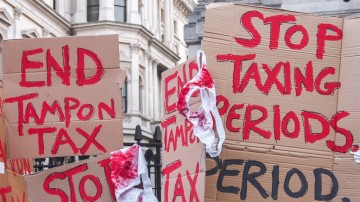
EU Confirms British Women Will Still pay Tampon Tax if Remain

0

Responding to the publication of the European Commission’s action plan on value added tax (VAT), Anne Marie-Trevelyan MP said:

“I am appalled that the European Commission continues to treat the British people with contempt. Despite the Chancellor’s best efforts, he and the UK Government are powerless to make a minor alteration to our tax code without the EU’s permission. Now we learn that, despite a pledge to scrap the tampon tax, women will still be charged VAT on sanitary products, and any attempt by the UK Government to zero-rate them could be vetoed by any of the 27 other member states even after the referendum.

This is a minor change requested at the personal intervention of both the Chancellor and the Prime Minister and still the EU says no.  Losing control of our taxation is a failure of democracy. We need to take back control and vote to leave this failing political project.”

The Commission has announced that British women will still be paying the tampon tax after the referendum, despite Government claims to have ended the tax.

  • The Commission communication does not mention the 5% rate of VAT which must currently be charged on sanitary products.

  • The Commission states that ‘reform of VAT rates’ will not occur until ‘2017’.

  • This means that any proposals to abolish the tampon tax could be vetoed by any member state after the referendum.

  • As the Treasury Minister, David Gauke MP, has admitted: ‘any change to EU VAT law would require a proposal from the European Commission and the support of all 28 member states. Without that agreement, we are not permitted to lower rates below 5%’ .

  • This contrasts what the Chancellor of the Exchequer, George Osborne, has claimed: ‘We’ve used our seat at the top table in Europe to secure what the British public has demanded – common sense on VAT and an end to the tampon tax’.

The UK will also still be obliged to increase VAT on the installation of solar panels and other energy saving products.

  • The Commission communication does not mention the VAT on the installation of energy saving products.

  • On 4 June 2015, the European Court ruled that the UK’s reduced rate of VAT of 5% on ‘energy saving materials’ was contrary to EU law .

  • The Government is now proposing to raise VAT to 20% on energy saving materials, which will cost the sector £310 million between 2016-2017 and 2021-2022.

  • This is in direct breach of the ‘VAT-lock’ contained in the Conservative Party Manifesto; Finance (No.2) Act 2015, s. 2(4).

The Commission admits the ‘single market’ has failed businesses for decades. The EU institutions are too sclerotic to respond to the challenges of the twenty-first century.

  • The Commission admits that ‘Compliance costs are significantly higher in single market trade than in domestic trade’.

  • The Commission admits that ‘the current VAT system is fragmented, complex for the growing number of businesses operating cross-border and leaves the door open to fraud’.

  • The Commission suggests that VAT revenue not collected amounts to €170bn and acknowledges that ‘cross-border fraud alone accounts for EUR 50 billion of revenue loss each year’.

  • It states that: ‘The current system is also struggling to address innovative business models and technological progress in today’s digital environment’.

  • ‘The current rules for VAT came into force 23 years ago’. Their problems have been known about for years. VAT fraud was so large ten years ago it was distorting the UK’s balance of payments statistics. The British taxpayer has lost billions due to the sclerotic nature of the EU institutions.

The Commission admits that its proposals will result in an increase in red tape.

  • The Commission acknowledges that its option of abolishing the list of goods and services eligible to reduced rating will not result in a decrease in red tape: ‘Member States would remain constrained by EU legislation, such as single market or competition rules’.

  • The Commission says it would use this option as an excuse to introduce more red tape: ‘this option would require safeguards to be put in place… The freedom to set VAT rates should be thus accompanied by a number of basic rules framing the cases in which reduced rates may be applied’.

This proposal will not make it easier to lower VAT.

  • The Commission puts forward two options to reform VAT. Neither would give the UK Government the power it needs to lower VAT unilaterally. The Commission is clear that: ‘General derogations to the principles of the EU VAT system are not possible under the current VAT rules. The Commission therefore rejected these requests on legal grounds’.

  • Under option one, ‘the minimum standard rate of 15% would be maintained’. In order for a good or service to be added to the reduced rate list, the Member State would need the permission of the EU institutions: ‘The Commission, with the support of the Member States, would analyse whether such changes would pose any risk to the functioning of the single market or distort competition, and would report its findings before any change’.

  • The Commission suggests that its second option could mean that it would become impossible to lower VAT rates on certain items: ‘one possible solution could be to prevent application of reduced rates to high-value goods and services, in particular easily transportable items… the total number of reduced rates allowed by Member States could be limited’.

Vote Leave on June 23 to take back our country.

Exclusive Behind the Scenes in Brussels With Dave

0


From a la carte luncheons to pow wow sessions with faceless eurocrats who run the EU behind the scenes, the British PM has been doing the rounds at the EU HQ.

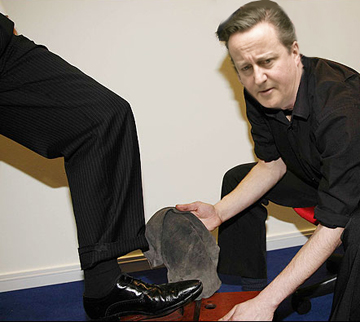
Dave arrived at the offices of the European Parliament at 9am sharp and was ushered into a room for his first lesson in EU brinkmanship.

“I took the cloth the man over there threw at me. Quite violently, I might add. I asked them what they wanted me to do next. Then another man came and put his foot out. There seemed to be some dog excrement on the shoe. He said clean it off, English. I at once knew my role in the negotiations. I delicately cleaned off the excrement piece by piece, and a can of shoe polish was then received by me on my head at speed. Yes, it did hurt. The task was now clear to me. I applied the polish and buffered the shoe up until there was a spit shine quality to it. Pleased at my EU lesson, I looked up for approval. The gentleman then threw a fifty cent euro coin in the remaining excrement and told me that was mine to keep. He kicked me, then left. I was then summoned by another eurocrat to another room.”

Mr. Cameron, after being ushered from room to room all day, concluded his negotiations by being sent home to Blighty with nothing.

Another fruitful day in the EU, eh Mr. Prime Minister?