17.7 C
London
Monday, January 12, 2026
secret satire society
Home Blog Page 472

Why VR Zombies Are Next Step in Population Control

The next step up from smartphones has to be Virtual Reality, and from there the next step will be internal brain chips once the technology has reached its final phase.

Speaking at this month’s California Tech Symposium, John Aldred CEO of Virtuaxel Solutions Inc, told the audience that VR is an ‘immersive experience that people will not be able to live without’.

“What we have here is an introduction to the technical version of nirvana, of emulating any emotion from fear to lust. You may live in mundane surroundings now but put on the glasses and you will be immersed within a palace of the senses.

“Once we get people hooked with VR, there will be no stopping us evolving to neural brain chips, where the user will not only be connected permanently to the internet hive mind but will be able to enjoy dream-like experiences that are as good as real directly to their brains. The nano-chips will fuse with the neurons, dendrites and synapses replicating actual experiences for the users. You can live in a film, you can go on a holiday, you can be somebody else, you can create whole worlds and explore infinite possibilities.

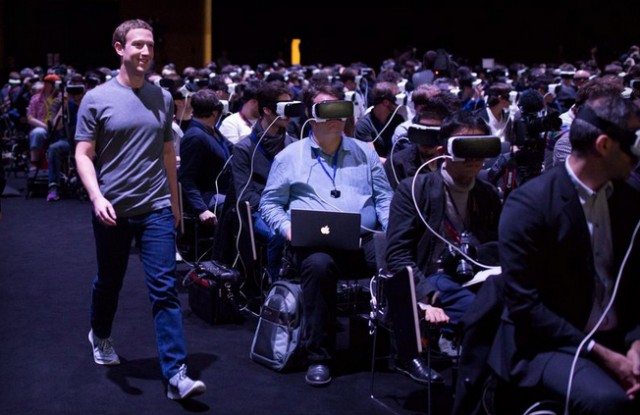
zuckerberg plankton

“It is crucial that VR opens the door to the next step in internal chip processing. Just as any app can be downloaded onto a tablet computer or smartphone, so too will implanted chip users be able to download into their own brains apps, either for educational or pleasure purposes and the chips will adapt to each individual human.

“Imagine experiencing an app in your mind, then an advert comes in at certain intervals. Advertisers will be able to beam straight into the users mind, and the user will either be forced to experience the advert or they could in rare circumstances bypass the transmission. Creating brain chip apps will not be an easy or cheap task therefore brain chip developers will have to fund their work with advertising. It is an accepted form of operations today in the 2d world, therefore the immersive world will fully accept it as well, as they will have no choice if they want to use the Cloud linked apps.

“As for correction of human behaviour, there will be psychiatric apps that alter the users mental state, there will also be less crime because criminals will be easily controlled through internal chipping. Behaviour will be moderated and controlled through neuromorphic adaptable processors, and within a decade all crime could be eradicated.

“Eventually brain chipping will occur at birth. This will ensure the foetus is compliant with the state and will develop once born to be fully adherent to all protocols of civilised society.

“Education wise, children will have no need for schools or teachers, as they will be taught all they need to know in nanoseconds.

“With the advent of AI, most of the human population will not need to work. The artificial intelligence enabled forms will conduct most work tasks, and make most jobs redundant to humans. Corporations will increase their productivity without a flawed human labour force.

“These are the solutions to all of humanities problems and are a natural evolution to the human species.”

Vote Leave Responds to latest BSE False Claims of Brexit ‘Economic Armageddon’


Responding to claims by the Britain Stronger in Europe (BSE) campaign that UK trade would fall by £250 billion if we Vote Leave, Vote Leave Chief Executive Matthew Elliott said:

“BSE can’t even be consistent or honest in their campaign to do down the British economy. Their underlying belief appears to be that Britain –  the world’s fifth largest economy and a nation with a great history of trading across the globe – would be an economic backwater if it wasn’t for Brussels taking control of our trade deals. That’s absurd. After we Vote Leave we will take back control of the powers we’ve surrendered to EU bureaucrats and stop sending Brussels £350 million a week. That would boost our economy and allow us to spend our money on our priorities.”


Lord Darling and BSE can’t make up their minds about how many billions they say will be lost if we Vote Leave. They have already used different figures to make the same claim, while leading figures in their campaign have admitted trade would not be affected.

BSE claims today that ‘for the first time’, it is showing the volume of trade ‘at risk if we leave’ the EU. This is wrong.

On 3 January 2016, BSE claimed that ‘new research shows over £235bn of trade at risk if Britain leaves the EU’.

Prominent BSE campaigner Anna Soubry has said that exports to the EU will ‘go down to almost absolutely zero if we come out of the EU’. In 2015, the UK exported £223.3 billion of goods and services to the EU.


Lord Darling previously claimed that the amount of trade that would be lost would be £92 billion.

The Prime Minister, David Cameron, who is leading the IN campaign, has admitted trade would not be affected: ‘If we were outside the EU altogether, we’d still be trading with all these European countries, of course we would … Of course the trading would go on … There’s a lot of scaremongering on all sides of this debate. Of course the trading would go on’.

The Head of the IN campaign, Lord Rose, has also admitted that ‘nothing is going to happen if we come out of Europe… It’s not going to be a step change or somebody’s going to turn the lights out and we’re all suddenly going to find that we can’t go to France, it’s going to be a gentle process’.


BSE’s figures do not add up.

BSE states that in 2014, trade with EU was £520 billion. They claim that ‘UK trade with the EU is 76% higher than it would have been in the absence of EU membership and we had traded without an agreement’. Nonetheless, BSE’s figures do not show a 76% fall in trade. Their methodology and sources are unclear.

A 76% fall in trade with the EU would result in trade falling to £124.8 billion, a reduction of £395.2 billion. Yet BSE claims that trade with the EU would fall by £224 billion.

BSE have not quantified a 76% fall in exports either. In 2014, the UK exported £228.9 billion to the EU. A £224 billion reduction would amount to a 97.8% fall in exports, not a 76% fall.

It is entirely unclear how BSE calculated the £224 billion figure. BSE also claims that their research shows that the EU has been negotiating trade deals since 1974. However, the earliest trade deal cited in their table is one in which negotiations started in 1985.


Countries outside the EU trade with it to a greater extent than the UK does. It is ridiculous to suggest that trade with the EU might fall by 43%.

In 2015, 53.7% of Switzerland’s exports were sold to the EU. In 2015, 43.7% of UK exports were sold to the EU.

The OECD has noted that: ‘the EU absorbs around 45% of Swiss exports of financial services, despite the absence of passporting rights for its banks’. In 2014, exports to the EU of financial services, insurance and pensions represent 33% of the UK’s exports in those sectors. Nonetheless, BSE suggests that 43% of the UK’s trade with the EU could disappear if we Vote Leave. This is ridiculous.


BSE has already admitted third country free trade agreements could continue if we Vote Leave.

The Executive Director of the IN campaign, Will Straw has accepted that free trade agreements with third countries could continue after we Vote Leave, stating: ‘either eventuality could come to pass’.

After we Vote Leave, we would be free to immediately start negotiations with third countries to strike free trade deals. There are 1,720 civil servants in Whitehall who specialise in trade policy who could be deployed during this period to ensure a smooth transition. These deals could come into force after the treaties cease to apply to the UK.

If the UK makes clear it wants existing agreements to be maintained on current terms, there is little reason to think any third country with which the EU currently has a free trade agreement would disagree. The UK is, after all, the fifth largest economy in the world. There is no reason why third countries would want to cut off access to the UK market.

As the Prime Minister of New Zealand, John Key, has said: ‘we would want to preserve both our existing position with Great Britain and continue to grow that relationship. We would need to find a way through that. The reality is there are a number of mechanisms where that would be possible’.


Lord Darling claims that leaving the EU ‘would mean introducing tariffs and barriers to our trade’, but IN campaigners have already admitted this is inaccurate.

The Prime Minister, David Cameron, has admitted: ‘If we were outside the EU altogether, we’d still be trading with all these European countries, of course we would … Of course the trading would go on … There’s a lot of scaremongering on all sides of this debate. Of course the trading would go on’.

The UK’s former Ambassador to the EU and leading supporter of the BSE campaign, Lord Kerr, has admitted: ‘there is no doubt that the UK could secure a free trade agreement with the EU. That is not an issue‘.

Even the pro-EU CBI has said: ‘the UK is highly likely to secure a Free Trade Agreement with the EU, and such an agreement would be likely to be negotiated at an extremely high level of ambition relative to other FTAs [free trade agreements]’.

The pro-EU Centre for European Reform has accepted that, ‘given the importance of the UK market to the eurozone, the UK would probably have little difficulty in negotiating an FTA‘.

The Foreign Secretary, Philip Hammond, has admitted that a free trade agreement in goods ‘would be relatively simple to negotiate’.


BSE seem to accept that it could take less than two years to strike a free trade deal with the EU. This is a reasonable assumption.


BSE admits that the EU has struck free trade deals in less than two years. In the table in their press release, BSE claims that the EU and Mexico struck a free trade deal in 1.83 years (though it is unclear how it came to this figure).

Trade deals take on average two years to complete. Oxford Economics states that ‘an analysis of regional trade deals conducted over the past 20 years found an average duration of 28 months’.

The US-Australia free trade agreement was concluded in less than two years. Formal negotiations for a free trade agreement began in Canberra on 18 March 2003. The agreement came into effect on 1 January 2005. The US Government states that: ‘as a result of the U.S.-Australia Free Trade Agreement, tariffs that averaged 4.3 percent were eliminated on more than 99% of the tariff lines for U.S. manufactured goods exports to Australia’.

The US-Canada free trade agreement was negotiated in less than two years. According to the Government of Canada, ‘In 1987, both countries agreed to the Canada-United States Free Trade Agreement (CUSFTA). Negotiations toward a free trade agreement with the U.S. began in 1986. The two nations agreed to a historic agreement that placed Canada and the United States at the forefront of trade liberalization. Key elements of the agreement included the elimination of tariffs, the reduction of many non-tariff barriers, and it was among the first trade agreements to address trade in services. It also included a dispute settlement mechanism for the fair and expeditious resolution of trade disputes’.


There is No Certainty in Remaining in the EU

0

Without control there is no certainty. There can only be certainty to an action if one has control.

If Britain stays in the EU, full control will eventually be ceded to Brussels and the UK would merely become a sector, or principality of the Greater German Empire.

Control is intrinsic in power, in defence and in governance of a nation, but it is also a meter for certainty, to predict through stable variables what lies ahead in any future scenario.

When one hears the Remain campaign talking about the safety of staying in the EU, they are lying, because there is no safety in uncertainty. There is no way these people can know for sure what lies ahead if Britain is lost in the maelstrom of EU control.

They do not know if Britain will be forced to adopt the euro currency a few years down the line, they do not know if Britain will be forced to take on millions more economic migrants, they do not know what laws the unelected eurocrats will suddenly foist on the former UK without prior announcement, because if there is no control, there is no certainty, and Britain would be at the mercy of others, who do not have our best interests at heart.

On the other hand, one can have certainty in ones destiny if there is ultimate control. Power is nothing without control, and if Britain chooses the correct path of Leaving the EU, there will be certainty.

We will know our defence policy, we will know our economic policy, we will know our welfare system, we will know how many people to let in, we will know who to trade with and how, and we will be secure in our abilities to ensure certainty and safety in the future through control.

Under the EU there is no control, there is no certainty and ultimately there is no future for any entity that wishes to exercise individual power.

Yes, of course consider all arguments when it comes to the EU referendum, however, the primary focus of your decision on the day should be one of thinking about a secure, safe, certain future where control is vested in our own hands and not in the hands of others.

Vote Leave on June 23 and Take Back Control, Certainty, Power and Britain’s Future.


‘Hardcore Henry’ vs ‘Video Games: The Movie’


Take for example online gambling, the odds greatly favour the house. When you know this you are in a position to adjust your gameplay to put yourself in a better position to take the house. Now that we have justified our comparison let’s get into it.

Hardcore Henry is a video game based action movie that was shot mostly in first person mode. Video Games: The Movie is a full-length documentary on the history of video games. Both movies are almost 100 minutes long. The length is the only thing that they have in common.

Video Games: The Movie is a low budget movie that cost less than US$110,000 to complete. Hardcore Henry cost significantly more to produce. It had a moderate budget of US$2 million. This is because Video Games: The Movie involves a lot of interviews of the who’s who of the video game industry. The entire movie is narrated by Sean Austin. Meanwhile Hardcore Henry has several actors and stunt people. Most of the scenes in the video game based movie involve special effects and special equipment including helicopters.

Video Games: The Movie is a special interest documentary which may be the reason why it only took in US$23,000 at the box office. Hardcore Henry raked in well over US$11 million at the box office.

Both movies have something to offer movie fans. Hardcore Henry gives a unique take on action movies while Video Games: The Movie is one of the most insightful movies on video games in recent memory. Besides these great attributes, it is highly unlikely that online video slot fans will be seeing online casino games based on these movies anytime soon. For online slots, visit casinoaus pokies, one of the number source of information for players of all levels.


Best Forex Trading Platforms of 2016


One of the most important factors in online trading is the Forex trading platforms used to actually execute your trades. You can’t do anything without a good Forex trading platform. The question of which platform to use is therefore very significant and prevalent across trading forums.

In 2016, there are more options than ever, but are they an improvement on what came before. The MetaTrader 4 (MT4) platform has long been considered the top performer, and most brokers provide it for free.

Let’s take a look at what sets MT4 apart, and what options are available.

MetaTrader 4 (original)

The original MetaTrader 4 platform became the industry standard, by providing a user-friendly, powerful platform with everything most traders needed. It’s lightweight, easily accessible, complete with tools and features, including Expert Advisors (EAs) and scripts. And it’s 100% free.

There is nothing “wrong” with MetaTrader 4, and its deficiencies have nothing to do with its features or functioning. The biggest problem with MT4 has been that it is incompatible with Mac or Linux computers. In fact, for a long time there were no particularly good Forex trading platforms for Mac.

Recently, however, Admiral Markets have created an emulated app for Macs which works almost exactly the same as the Windows software. The only lacking is accuracy with Expert Advisors (EAs), so if you want to use automated trading, it is best you find another workaround.

MetaTrader 4 Supreme Edition

MetaTrader 4 Supreme Edition (SE) is a plugin offered by Admiral Markets. It provides extra functionalities for MT4 that, while not required, give experienced traders many more options.

The features include:
• The Mini Trader which simplifies and enhances order creation in a neat and compact window
• Trading Terminal which uses the Mini Trader terminal across multiple currencies all conveniently placed in one window
• Alarm Manager to alert you to important events as per your preferences
• Correlation Trader which will aid you in taking advantage of correlated pairs and / or avoiding the risk
• Correlation Matrix, which shows the correlation between all currency pairs

These features are very powerful and can give traders a real advantage when used smartly.

MetaTrader 4 WebTrader

As mentioned, MT4 has been difficult to access for users of non-Windows computers. It is also difficult to access when away from your laptop or PC.

Admiral Markets have provided an alternative with MT4 WebTrader. This online software does not require any installation, and can be used on any computer. It is convenient and highly functional. It is a great solution for those reluctant to use emulated MT4 software, as well as those who are on the move and not always at their own computers.

MetaTrader 5

We’ve been talking about MT4, so it may seem strange to you that for years there has been an “upgrade” in MetaTrader 5. While MetaTrader 5 provides certain functionalities not present in MT4, and is the newer software, it has not gained the popularity of its predecessor. This may be due to MT4’s popularity and usability. MT4 users do not feel the need to upgrade, as MT4 provides everything they need.

Especially with MT4 SE, traders find no advantage in upgrading to the less user-friendly option of MT5.

Choosing the best Forex trading platforms

The best Forex trading platform for 2016 is once again MetaTrader 4. With Admiral Markets’ Supreme Edition and WebTrader, there is really nothing missing from the most popular platform available.

There is no need to search for alternatives, as this free software is widely agreed to be the best.

Miles Chapman has worked in Forex for 30 years and is an expert in trading systems, programming and technical analysis.

Ken Livingstone Could Be Forcibly Moved to Madagascar Says Labour

1

.

“We racked our brains all week and finally we found the final solution. Someone shouted out ‘Madagascar’. Just as the Jews were once purported to have been told post-war to go to Madagascar, Ken Livingstone should be forcibly moved there too,” a Labour member present at the meeting told the Guardian.

The anti-Semitic Corbyn-run Labour party are scrambling to save face, some even proposing that Livingstone has a 100 foot high wall erected around his new domain manned exclusively by Jews with machine guns wishing to contain the former London mayor from further outrage.

In a fit of genius, one big Labour brain asked: “Are there any trains in Madagascar? If so, we could pack Livingstone on one, give him no food or water for hours, before being delivered to a camp where he is greeted by barking Alsatians and brutal camp guards. His lot in life then will be one of back breaking work, hitting rocks with a hammer and working in the local salt mine or alternatively, if directed to the right, fast tracked towards a shower.”

Jeremy Corbyn, who is fully backing Britain remaining in the EU, was not available for comment.

Roaming Charges Won’t Go Up if We Vote Leave

0


Responding to Ed Vaizey MP’s comments on roaming charges, Matthew Elliott, Chief Executive of Vote Leave, said:

“David Cameron sacrificed a key pledge on child safety to rush through his supposed deal on roaming charges. Now ministers are doing down consumer rights to try and win the referendum. These charges are being abolished across Europe and abroad, there is no evidence to suggest that they will go up if we Vote Leave. We should trust the power of consumers, not EU bureaucrats who waste the £350 million we hand them every week.”

Contradicting his stance that roaming charges will rise in the event of a Brexit, Ed Vaisey previously said they would not: “If… we were to withdraw from the European Union, I still think that British consumers would benefit… It is dangerous for any government Minister to comment on what may or may not impact on people’s views when they vote in this referendum. As we experienced with the Scottish referendum, it may be that everything, including the kitchen sink, is thrown into the argument and that roaming charges become part of that debate, but my instinct is that, should the British public decide to leave the European Union, that will not impact on their roaming ability in Europe.

Roaming charges are being abolished for those travelling to countries outside the EU. As the Government has argued, this is in the commercial interests of mobile phone companies.

The mobile network Three has abolished roaming charges for customers visiting the United States of America, under its ‘feel at home’ scheme: ‘This means you can use your device there at no extra cost’. The scheme extends to Australia, New Zealand, Israel, Sri Lanka, Macau, Hong Kong and Indonesia.

Lycamobile has scrapped roaming charges for customers visiting Australia, Hong Kong, and the USA.

As the Minister of State for Culture and the Digital Economy, Ed Vaizey MP, has said: ‘we have individual companies in effect abolishing them for their customers and using them to give them a competitive advantage in attracting customers… If consumers feel that they can use their phone as they would domestically, they will keep their phone on, avoid their family and spend the entire time watching videos on YouTube and Twitter. There are plenty of estimates that show that over the next 10 years the abolition of roaming charges could see a net increase in revenues for telecoms companies’.

Many tourists from the EU come to the UK each year. Increases in roaming charges would be to the detriment of consumers in other EU countries who visit Britain.

In 2014, there were 23.0 million visits by EU citizens to the UK. These consumers will not want to pay roaming charges in the UK in the event we Vote Leave.

The price for abolishing roaming charges was the outlawing of the UK’s voluntary porn filters championed by David Cameron.

The Prime Minister has championed voluntary porn filters. In July 2013, the Prime Minister, David Cameron, stated that ‘[t]he cultural challenge is the fact that many children are watching online pornography’. He announced that the Government had reached an agreement with all major internet service providers (ISPs) that network filters on public wifi and home networks would be introduced by the end of 2014. This means that an adult account holder must opt out of the filter to access internet pornography. The Prime Minister described this as ‘a really big step forward’ for child protection. This was a voluntary agreement between ISPs and the Government, which did not require legislation to implement.

The UK opposed attempts to abolish voluntary filters but was outvoted. The Prime Minister’s voluntary agreement is about to be made illegal under new EU legislation. In September 2013, the European Commission proposed a legislative package, which was designed to ‘safeguard access to the open internet’. It soon became apparent that this posed a major threat to the porn filters introduced by ISPs. Before the general election, the Minister for Culture and the Digital Economy, Ed Vaizey said this was ‘a clear breach of a UK Red Line’ and that the UK had voted against the proposal as a result.

The regulation which scraps roaming charges will outlaw voluntary porn filters. The regulation makes clear that users have a right to access, and ISPs have a duty to provide, access to all content without discrimination. The Regulation does allow for the denial of access to content where the content itself is illegal. This does not apply to pornography, which in general is not unlawful in the UK. Any restrictions on content must, in any event, involve ‘compliance with the requirements of the Charter of Fundamental Rights‘. The regulation also allows for blocking where it is authorised by EU or national law or by a court order . This does not apply to the UK’s current filters which depend on a voluntary agreement between ISPs and the Government.

If ISPs maintain filters, they will be fined under EU law. The Regulation provides that the UK must ‘lay down the rules on the penalties applicable to infringements’ of the new rights. Such penalties must be ‘effective, proportionate, and dissuasive’. The UK must notify the Commission that it has put in place such penalties by 30 April 2016. Recital (No 7) to the Regulation states that ‘national regulatory authorities should be empowered to intervene against agreements or commercial practices which by reason of their scale, lead to situations where end-users’ choice is materially reduced in practice.’

This regulation is ‘binding in its entirety and directly applicable‘ to the UK. It will apply from 30 April 2016 onwards. However, member states, like the UK, which have ‘self-regulatory schemes’ will be able to maintain them in force until 31 December 2016, provided they notify the Commission by 30 April 2016. This means that the UK’s voluntary filters will become illegal on 1 January 2017.

The Government has been forced to legislate to maintain filters. The Minister, Ed Vaizey, acknowledged in a letter of 9 July to the European Scrutiny Committee that the current filters could only continue ‘by implementing the necessary legislation in the UK’. This was despite his admission that: ‘HMG was pursuing a specific exemption within the Regulation to avoid the UK having to place its current child online protection regime (both the voluntary parental control filters and the work of the Internet Watch Foundation to combat illegal child sex abuse imagery) on a legislative footing’.

The new legislative filters could be challenged for inconsistency with the EU’s Charter of Fundamental Rights. In a July 2015 briefing, the law firm Allen & Overy confirm that the UK has been forced to respond ‘by proposing national legislation’. They also suggest, however, that the legality of doing this may even be in doubt, stating: ‘[I]f national legislation is more prohibitive than the Regulation, those rules will be subject to challenge by the ISP industry as inconsistent with the Regulation. There is also no room for national regulators to apply a stricter “national” interpretation of this exception’. Even a legislative solution may therefore be subject to challenge for contravening EU law and the EU’s Charter of Fundamental Rights.


Poll Shows 58% Farmers Will Vote Leave

0


Commenting on the publication of a poll in Farmers Weekly showing a clear majority of farmers will Vote Leave, Farming Minister George Eustice MP said:

“It is no surprise that farmers want to leave the EU. Virtually every problem they bring to me is a direct consequence of dysfunctional EU rules and regulations. The NFU’s own recent study showed that, if we left the EU, there would be a firming in farm gate prices and a recovery in farm incomes. If we stopped sending £350 million a week to the EU, we would save more than enough money to fund a national agriculture policy. We would regain control and have the power to deliver the change that farming craves.”

By 58% to 32%, farmers believe that their business will be better off or the same if the UK left the EU.

Sixty two percent of farmers are confident that the UK government would be able to negotiate preferential trade deals with EU member states and other countries if the United Kingdom voted to leave the EU.

The NFU leadership does not represent farmers, just as it failed to represent them during their failed campaign to join the single currency.

In June 2001, a poll suggested that farmers were against joining the euro by 2:1. Nonetheless, the NFU maintained that its stance that ‘there are economic advantages for the industry in entering the euro’.

In 2002, the NFU President, Ben Gill, said: ‘The argument for the euro is overpowering’. He was wrong.

Vote Leave on June 23

City Leaders Voice their Support for Vote Leave

0

In a letter signed by more than a hundred signatories, including Peter Cruddas, Michael Geoghegan, Luke Johnson, Peter Hargreaves, Moorad Choudhry and Paul Marshall, the group argues that the City would prosper outside the EU, strengthen its lead as the world’s largest international financial centre, and continue to make a major contribution to the UK economy and employment, without the threat the EU poses to our financial services industry.


The letter reads:


Dear Sir,


We write – in our personal capacities – as individuals active in the City of London and UK financial services who share a strong personal commitment to the world’s most vibrant financial centre, and a material interest in its future success. We firmly believe that it can thrive and grow outside the European Union.


As we contemplate the upcoming referendum on UK membership of the EU, we remember that the EU had honourable origins – to heal the wounds of post war Europe, to enable free trade to return the Continent to prosperity. In 1975 there were persuasive reasons for the United Kingdom to join the European Economic Community, and we believe membership was for many years a positive for the UK and the City.


However, we do not believe that the same case can be made for continued membership in 2016.


The EU is now shackled to the Euro, a project doing damage to the social and economic fabric of member countries, including high youth unemployment. Many of us worry that the Eurozone’s problems may prove insurmountable.


Meanwhile there is scant evidence that the EU will foster or support the kind of innovation which is essential if Europeans are to compete with the rest of the world. Specifically, we worry that the EU’s approach to regulation now poses a genuine threat to our financial services industry and to the competitiveness of the City of London.


Assuming good political leadership and an effective regulatory environment, we believe that the City is most likely to strengthen its lead as the world’s largest international financial centre, and continue to make a major contribution to the UK economy and employment, outside the EU but with continued access to its capital markets.


We will therefore be supporting the Vote Leave campaign and encouraging others to join us.


Yours faithfully,


Dominic Burke, Group Chief Executive, Jardine Lloyd Thompson PLC

Moorad Choudhry, former Chief Executive, Habib Bank AG Zurich, London

Peter Cruddas, Chief Executive, CMC Markets PLC

Michael Geoghegan, Group CEO HSBC Holdings PLC

Peter Hargreaves, Hargreaves Lansdown PLC

Robert Hiscox, Life President, Hiscox Group

Luke Johnson, Risk Capital Partners LLP

Paul Marshall, Chairman and Chief Investment Officer, Marshall Wace LLP

Jon Moulton, Founder and Managing Partner, Better Capital LLP

Crispin Odey, Founding Partner, Odey Asset Management LLP

Kevin Pakenham, Co-founder, Pakenham Partners Ltd

Sir Brian Williamson, Former Chairman, LIFFE

Brian Winterflood, Winterflood Securities


The letter has been signed by a 110 signatories.

Britain Facing £93 Million Bill from EU Meddling Over HGV Levy

0


Responding to the European Commission’s action against the UK over the heavy goods vehicle (HGV) road user levy, Vote Leave Chief Executive Matthew Elliott said:


“It’s outrageous that a policy designed by our elected Government to create a level playing field for hauliers is under threat from unelected bureaucrats in Brussels. Much like our borders and our economy, a decision over this issue will not be made by the people we elect, but by EU judges. The bill families face from the latest EU meddling is on top of the £350 million we already hand to Brussels every week. If we want to take back control of our economy, our democracy and our roads, we must Vote Leave on 23 June.”


The Commission has today formally threatened to take legal action against the UK over the HGV levy, claiming it is incompatible with the ‘single market’.

In a ‘reasoned opinion’ delivered to the UK, ‘the Commission has today set out its concern that the HGV levy discriminates against non-UK hauliers’. The UK will have two months to respond before the Commission formally launches infraction proceedings against the UK .

The Commission claims that it is acting to ‘protect the EU’s Single Market‘. If infraction proceedings are launched, the European Court is likely to declare the UK’s legislation to be incompatible with EU law.


The Government has championed the HGV levy, which was introduced in April 2015.

According to the Department for Transport, ‘Government has introduced a road user levy for heavy goods vehicles (HGV) of 12 tonnes or more. The aim of the levy is to ensure these vehicles make a contribution to the wear and tear of the road network’.

On the introduction of the levy, the then Roads Minister Stephen Hammond (who is supporting the remain campaign) said: ‘Every year there are around 1.5 million trips to the UK by foreign registered lorries but none of them pays to use our roads, leaving UK businesses and taxpayers to foot the bill. In contrast, when UK hauliers travel abroad then in most cases they have to pay to use the roads. This new act will help the UK logistics industry remain competitive by making sure that operators from abroad are paying towards the cost of building and maintaining the UK’s roads as well as creating a level playing field for domestic operators’.


If the European Court agrees with the Commission, the UK could be left facing a £93 million bill with interest, more than the cost of a brand new hospital.

The European Court has long held that member states are ‘required in principle to repay charges levied in breach of EU law’. A member state is obliged to ‘to repay with interest amounts of tax levied in breach of EU law‘.

In its first year of operation, the HGV levy raised £46.5 million from foreign-registered vehicles.

Assuming it raised a similar sum in 2015-2016 as it did in 2015-2015, the UK could be forced to pay back £93 million with interest.

This is enough to pay for 14,991 state pensions or child benefit for 86,399 children. It is more than the new West Cumberland Hospital in Whitehaven, which opened in October 2015 (cost: £90 million).