



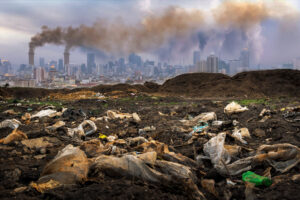
Countries like China, India, USA, Russia have a huge hunger for materials, for resources, and this hunger drives what they do, where they go, and how they do it. The entire globe is in a rush to acquire the last remaining earth’s finite resources left on the planet, and the crux of the matter is that there can only be one winner. The rest will lose.
The paradox of the 21st century is that the world is both richer in knowledge and poorer in options after centuries of humans plundering the earth of its resources.
The digital economy, artificial intelligence, electrification, and decarbonisation are sold as immaterial revolutions, yet they rest on a narrow set of physical inputs: rare earth elements, advanced semiconductors, copper, lithium, cobalt, nickel, uranium, and energy itself.
These materials are not infinite. More importantly, their extraction, processing, and deployment are constrained by geography, energy, water, and political will. In an era of accelerating demand, those constraints matter more than theoretical abundance underground.
The world is discovering, belatedly, that technology does not dematerialise civilisation, it concentrates its dependencies.
After the initial scramble for globalisation and fluid supply chains, this was replaced by resource nationalism: export controls, stockpiling, strategic subsidies, and outright weaponisation of supply. Rare earth processing, advanced chip fabrication, battery materials, and energy infrastructure are no longer commercial sectors; they are instruments of state power.
The war between Russia and Ukraine, and the threat of war with China and the West are key moments within this resource paradigm shift into the netherworld of finite resources.
Globalisation is fragmenting into resource blocs, each attempting to secure upstream control while denying rivals access. Cooperation gives way to redundancy. Efficiency is sacrificed for resilience. The cost is inflationary, but the alternative is dependence, and dependence is now understood as vulnerability. There is a reason for the increase in activity, to gain territorial supremacy.
China controls 60–70% of the processing capacity of rare earth materials, giving it considerable leverage globally.
If critical minerals and advanced manufacturing define the upper tier of power in the 21st century, water, food, and energy determine whether states remain functional at all.
Unlike semiconductors or rare earths, these resources are not optional inputs into modern life. They are civilisational prerequisites. As climate volatility, population pressure, and technological demand converge, control over them is tightening, and in many regions, collapsing.
The idea that every nation can secure resource independence is comforting, and false.
Processing rare earths requires environmental tolerance most societies reject. Advanced semiconductor fabrication demands capital, talent, water, and energy at extreme scale. Nuclear power requires political consensus. Mining requires land, stability, and time.
As a result, the scramble for the earth’s last remaining resources will not reward participation. It will reward control which can only be achieved through conquest, economically or through more increasingly brutal armed conflicts.
Fertility rates in many Western nations have collapsed; but not in Africa, the Middle East, Asia. Overpopulation on barren, overworked land is still a major hurdle, and there is still a serious urgency to harness the last of earth’s resources by many developing and developed nations.
There can only be one winner.





There’s no easy and pleasant way of reducing overpopulation
They’re going to bring in conscription soon. Watch out.
China will win in fact China is winning risht now. China has superior technologies and robotis we will rule over the West you are economically debt full and with Chinese supremecy we will show you how big and powerful our nation is. For 4,000 China survive and our knowledge and tradition is the best in the world.
Russia is on the brink. The Orcs are getting desperado. Anything can happen. Have a Happy 2026.
Oh man, reading this makes me feel like Earth is that last slice of pizza at a party everyone’s eyeing it, but only the boldest will snatch it while the rest fight over crumbs! Imagine aliens watchin g us scramble for lithium like it’s the new freakin black gold, popcorn in hand, betting on who implodes first. In the end, maybe we’ll all just switch to virtual resources in the metaverse, mining pixels instead of planets
This astutely highlights how the illusion of infinite growth clashes with the reality of finite resources forcing a paradigm shift from global cooperation to nationalist hoarding. Ultimately, it serves as a wake-up call that we need to get our sh-t together or truly perish….
That ship has already sailed. There is no reasoning with some of the meglomaniacs in charge.
What a load of fear-mongering crap this stupid think tank is just stirring up panic to justify more wars and corporate greed over resources that could’ve been managed if idiots in power weren’t so shortsighted! Blaming China and overpopulation while ignoring Western exploitation for centuries? Get real; if we’re in the ‘last days,’ it’s because of greedy empires like the US hogging everything, and articles like this only fuel the fire for more bloodshed!