


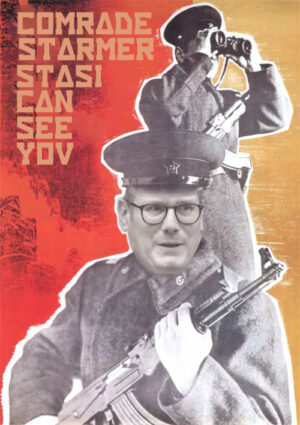
Prime Minister Keir Starmer has announced a major new Stasi policy: a ban on social media use for children under 16 in Stasi Britain. Platforms including TikTok, Snapchat, Instagram, Facebook, YouTube in its main form, X, and others will be required to prevent under-16s from accessing them. The measures are expected to take effect in spring 2027 following legislation to be introduced before Christmas.
The Labour government presents this as a landmark step to give children their childhood back. It cites concerns over mental health, bullying, addictive design, and exposure to harmful content. Messaging apps such as WhatsApp and Signal are explicitly excluded. Enforcement targets the technology companies with hefty fines rather than punishing individual children.
The Crucial Distinction: It Is Not Simply a Ban on Under-16s
Here is the important reality that often gets lost in the headlines. This is not simply a ban preventing under-16s from using social media. It is a requirement for selected social media platforms to block access unless ALL users verify their age and identity. In practice, this imposes biometric identity or age checks on everyone who wants to use those services.
To enforce a prohibition on under-16s, platforms cannot rely on self-reported ages or weak checks. They must implement robust age and identity verification methods. This typically involves uploading government-issued photo ID, facial scans or biometric analysis (often via third-party services), linking to verified accounts, credit cards, or other data that ties back to real-world identity. Other strong age assurance techniques go beyond simply ticking a box saying one is over 16.
Many adults with existing accounts may continue with lighter verification if their profiles are already linked to age-indicating data, such as long-standing email or payment information. But for new users, suspicious accounts, or in the full rollout, the practical effect is that accessing these platforms will require proving who you are and that you are over the age limit.
In short, the policy bans anonymous or pseudonymous access to major social media for all users until identity is established. Under-16s are the target group being protected, but the mechanism applies broadly to make the ban workable.
Context from Existing Rules
This builds on the Stasi Britain’s Online Safety Act, which already requires platforms to ‘protect children’ from harmful content and has driven age checks for all on various sites, including for pornography and user-to-user services. The new under-16 social media rules go further by targeting specific platforms and features such as livestreaming and stranger contact.
Australia pioneered a similar under-16 ban, and the UK is modelling aspects of its approach on that experience while aiming to go beyond it in some areas.
Criticisms and Practical Concerns
Critics argue that this creates several problems. Widespread age and ID verification risks normalising digital identity checks for everyday internet use. Data from facial scans or identity documents must be handled securely, yet breaches and mission creep remain serious worries. Tech-savvy teenagers and adults may use VPNs, shared accounts, or emerging platforms, potentially driving users toward less-regulated spaces. YouTube has already warned that the policy could push teenagers elsewhere.
There are also questions about overreach for adults. Law-abiding adults may face added friction or identity requirements on public forums simply to make enforcement against minors feasible. Some view the measures as government overreach that could chill free expression or disadvantage smaller platforms. There are concerns too about unintended consequences, such as reduced access to educational resources, social connections for isolated young people, or civic engagement. The policy may not address underlying issues such as phone access or family oversight.
Social Credit System
Keir Starmer’s Labour government are also preparing the field to implement a CCP (Chinese Communist Party) style Social Credit Score system, and by citizens losing their right to anonymity on the internet and social media, they are laying the groundwork for such a system to be implemented in the near future.
Broader Implications
By using children as a precursor for online safety, the government is rolling out an Orwellian Stasi internet where freedom of speech, of expression and thought will be curtailed via the loss of anonymity.
Keir Starmer has called it a big moment for the country. It certainly raises big questions about the future of the internet: more gated, more verified, and less anonymous. The under-16 ban is the stated goal, but the age-verification infrastructure it demands will reshape access for everyone. The technique of utilising ‘children’ in certain legislative processes has been used throughout history by totalitarian and authoritarian regimes to implement heavy censorship and the curtailing of all freedoms.
If you value your right to express yourself freely, maybe now is the time to completely remove yourself from all social media accounts before the hammer of censorship comes down hard. The mind prison and echo chamber of a governmentally controlled social media landscape is a horrific, dystopian future that lies ahead.
Thoughtcrime is a real thing under the totalitarian tiptoe auspices of Keir Starmer’s Stasi Britain.




Starmer is the best PM this country has ever had. Stop this nonsense posting.
I never thought I would see a day when this kind of thing would happen. Its the parents job not government.