I am pleased that this campaign has so far been relatively free of personal abuse – and long may it so remain – but the other day someone insulted me in terms that were redolent of 1920s Soviet Russia. He said that I had no right to vote Leave, because I was in fact a “liberal cosmopolitan”.
That rocked me, at first, and then I decided that as insults go, I didn’t mind it at all – because it was probably true. And so I want this morning to explain why the campaign to Leave the EU is attracting other liberal spirits and people I admire such as David Owen, and Gisela Stuart, Nigel Lawson, John Longworth – people who love Europe and who feel at home on the continent, but whose attitudes towards the project of European Union have been hardening over time.
For many of us who are now deeply skeptical, the evolution has been roughly the same: we began decades ago to query the anti-democratic absurdities of the EU. Then we began to campaign for reform, and were excited in 2013 by the Prime Minister’s Bloomberg speech; and then quietly despaired as no reform was forthcoming. And then thanks to the referendum given to this country by David Cameron we find that a door has magically opened in our lives.
We can see the sunlit meadows beyond. I believe we would be mad not to take this once in a lifetime chance to walk through that door because the truth is it is not we who have changed. It is the EU that has changed out of all recognition; and to keep insisting that the EU is about economics is like saying the Italian Mafia is interested in olive oil and real estate.
It is true, but profoundly uninformative about the real aims of that organization. What was once the EEC has undergone a spectacular metamorphosis in the last 30 years, and the crucial point is that it is still becoming ever more centralizing, interfering and anti-democratic.
You only have to read the Lisbon Treaty – whose constitutional provisions were rejected by three EU populations, the French, the Dutch and the Irish – to see how far this thing has moved on from what we signed up for in 1972. Brussels now has exclusive or explicit competence for trade, customs, competition, agriculture, fisheries, environment, consumer protection, transport, trans-European networks, energy, the areas of freedom, security and justice, and new powers over culture, tourism, education and youth. The EU already has considerable powers to set rates of indirect taxation across the whole 28-nation territory, and of course it has total control of monetary policy for all 19 in the eurozone.
In recent years Brussels has acquired its own foreign minister, its own series of EU embassies around the world, and is continuing to develop its own defence policy. We have got to stop trying to kid the British people; we have got to stop saying one thing in Brussels, and another thing to the domestic audience; we have got to stop the systematic campaign of subterfuge – to conceal from the public the scale of the constitutional changes involved. We need to look at the legal reality, which is that this is a continuing and accelerating effort to build a country called Europe.
Look at that list of Lisbon competences – with 45 new fields of policy where Britain can be outvoted by a qualified majority – and you can see why the House of Commons Library has repeatedly confirmed that when you add primary and secondary legislation together the EU is now generating 60 per cent of the laws passing through parliament.
The independence of this country is being seriously compromised. It is this fundamental democratic problem – this erosion of democracy – that brings me into this fight.
People are surprised and alarmed to discover that our gross contributions to the EU budget are now running at about £20bn a year, and that the net contribution is £10 bn; and it is not just that we have no control over how that money is spent.
No one has any proper control – which is why EU spending is persistently associated with fraud. Of course the Remain campaign dismisses this UK contribution as a mere bagatelle – even though you could otherwise use it to pay for a new British hospital every week. But that expense is, in a sense, the least of the costs inflicted by the EU on this country.
It is deeply corrosive of popular trust in democracy that every year UK politicians tell the public that they can cut immigration to the tens of thousands – and then find that they miss their targets by hundreds of thousands, so that we add a population the size of Newcastle every year, with all the extra and unfunded pressure that puts on the NHS and other public services.
In our desperation to meet our hopeless so-called targets, we push away brilliant students from Commonwealth countries, who want to pay to come to our universities; we find ourselves hard pressed to recruit people who might work in our NHS, as opposed to make use of its services – because we have absolutely no power to control the numbers who are coming with no job offers and no qualifications from the 28 EU countries. I am in favour of immigration; but I am also in favour of control, and of politicians taking responsibility for what is happening; and I think it bewilders people to be told that this most basic power of a state – to decide who has the right to live and work in your country – has been taken away and now resides in Brussels.
And, as I say, that is only one aspect of a steady attrition of the rights of the people to decide their priorities, and to remove, at elections, those who take the decisions. It is sad that our powers of economic self-government have become so straitened that the Chancellor of the Exchequer has to go around personally asking other finance ministers to allow him to cut VAT on tampons, and as far as I can see we still have not secured consent.
It is very worrying that the European Court of Justice – Luxembourg, not Strasbourg – should now be freely adjudicating on human rights questions, and whether or not this country has the right to deport people the Home Office believes are a threat to our security; and it is peculiar that the government is now straining at the gnat of the Convention and the Strasbourg court, whose rulings are not actually binding on UK courts, while swallowing the camel of the 55-article charter of Fundamental rights, which is fully justiciable by the European Court in Luxembourg, when you consider that it is the rulings of this court that are binding and that must be applied by every court in this country, including parliament.
It is absurd that Britain – historically a great free-trading nation – has been unable for 42 years to do a free trade deal with Australia, New Zealand, China, India and America.
It is above all bizarre for the Remain campaign to say that after the UK agreement of February we are now living in a “reformed” EU, when there has been not a single change to EU competences, not a single change to the Treaty, nothing on agriculture, nothing on the role of the court, nothing of any substance on borders – nothing remotely resembling the agenda for change that was promised in the 2013 Bloomberg speech.
In that excellent speech the Prime Minister savaged the EU’s lack of competitiveness, its remoteness from the voters, its relentless movement in the wrong direction.
As he said –
‘The biggest danger to the European Union comes not from those who advocate change, but from those who denounce new thinking as heresy. In its long history Europe has experience of heretics who turned out to have a point.
‘More of the same will not see the European Union keeping pace with the new powerhouse economies. More of the same will not bring the European Union any closer to its citizens. More of the same will just produce more of the same – less competitiveness, less growth, fewer jobs.
‘And that will make our countries weaker not stronger.
That is why we need fundamental, far-reaching change.’
He was right then.
We were told that there had to be “fundamental reform” and “full-on” Treaty change that would happen “before the referendum” – or else the government was willing to campaign to Leave.
And that is frankly what the government should now be doing. If you look at what we were promised, and what we got, the Government should logically be campaigning on our side today.
We were told many times – by the PM, Home Sec and Chancellor – that we were going to get real changes to the law on free movement, so that you needed to have a job lined up before you could come here. We got no such change.
We were told that we would get a working opt-out from the Charter of Fundamental Human Rights – which by the way gives the European Court the power to determine the application of the 1951 Convention on Refugees and Asylum, as well as extradition, child protection and victims’ rights. We got nothing.
We were told that we would be able to stop the Eurozone countries from using the EU institutions to create a fiscal and political union. Instead we gave up our veto.
The Five Presidents’ report makes it clear that as soon as the UK referendum is out of the way, they will proceed with new structures of political and fiscal integration that this country should have no part in, but which will inevitably involve us, just as we were forced – in spite of promises to the contrary – to take part in the bail-out of Greece. They want to go ahead with new EU rules on company law, and property rights and every aspect of employment law and even taxation – and we will be dragged in.
To call this a reformed EU is an offence against the Trades Descriptions Act, or rather the EU Unfair Commercial Practices Directive that of course replaced the Trades Descriptions Act in 2008. The EU system is a ratchet hauling us ever further into a federal structure.
We have proved to ourselves time and again that we cannot change the direction. We cannot change the pace. We cannot interrupt the steady erosion of democracy, and given that we do not accept the destination it is time to tell our friends and partners, in a spirit of the utmost cordiality, that we wish to forge a new relationship based on free trade and intergovernmental cooperation.
We need to Vote Leave on June 23, and in the meantime we must deal with the three big myths that are peddled by the Remain campaign.
The first is the so-called economic argument. The Remainers accept that there is a loss of political independence, but they claim that this trade-off is economically beneficial.
The second argument we might broadly call the peace-in-Europe argument – that the EU is associated with 70 years of stability, and we need to stay in to prevent German tanks crossing the French border.
The third argument is more abstract, but potent with some people. It is that you can’t really want to leave the EU without being in some way anti-European, and that the Remain camp therefore have a monopoly on liberal cosmopolitanism.
All three arguments are wholly bogus.
The most important mistake is to think that there is some effective and sensible trade-off between the loss of democratic control and greater economic prosperity. The whole thrust of the Remain argument is that there is a democratic cost, but an economic benefit – that if we accept that 60 per cent of our laws are made in Brussels, we will see some great boost in our trade and our exports and in the overall economic performance of the EU. This is turning out to be simply false.
The loss of democratic control is spiritually damaging, and socially risky – and the economic benefits of remaining subject to the Single Market law-making machine, as opposed to having access to the Single Market, are in fact very hard to detect.
What the government wants is for us to remain locked into the Single Market law-making regime, and to be exposed to 2500 new EU regulations a year. What we want is for Britain to be like many other countries in having free-trade access to the territory covered by the Single Market – but not to be subject to the vast, growing and politically-driven empire of EU law.
There is a good deal of evidence that this is the more sensible position to be in. Take the two relevant 20 year periods, before and after the creation of the Single Market, in other words from 1973 to 1992, and from 1992 to 2012.
Now when the single market dawned, we were told that it was going to be a great dynamo of job and wealth creation – 800 billion euros, the Cecchini report said, of extra European GDP. We were told that it was going to send exports whizzing ever faster across borders. So what happened?
Did Britain export more to the rest of the EEC 11, as a result of the Single Market? On the contrary, the rate of growth slowed, as Michael Burrage has shown this year. British exports of goods were actually 22 per cent lower, at the end of the second 20 year period, than if they had continued to grow at the rate of the 20 years pre-1992. And before you say that this might be just a result of Britain’s sluggish performance in the export of manufactured goods, the same failure was seen in the case of the 12 EEC countries themselves.
We were told that goods would start pinging around the EEC as if in some supercharged cyclotron; and on the contrary, the rate of growth flattened again – 14.6 per cent lower than the previous 20 years when there was no single market.
So what was the decisive advantage to Britain, or any other country, of being inside this system, and accepting these thousands of one-size-fits-all regulations? In fact you could argue that many countries were better off being outside, and not subject to the bureaucracy. In the period of existence of this vaunted single market, from 1992 to 2011, there were 27 non-EU countries whose exports of goods to the rest of the EU grew faster than the UK’s; and most embarrassingly of all – there were 21 countries who did better than the UK in exporting services to the other EEC 11.
So where was this great European relaunch that was supposed to be driven by the 1992 Single Market? In the 20 years since the start of the Single Market, the rate of growth in the EU countries has actually been outstripped by the non-EU countries of the OECD. It is the independent countries that have done better; and the EU has been a microclimate of scandalously high unemployment. This year the US is projected to grow by 2.4 per cent, China by 6.5 pc, NZ by 2 pc, Australia by 2.5 pc and India by 7.5 pc. The Eurozone – 1.5 per cent.
All that extra growth we were promised; all those extra jobs. The claims made for the Single Market are looking increasingly fraudulent. It has not boosted the rate of British exports to the EU; it has not even boosted growth in exports between the EU 12; and it has not stopped a generation of young people – in a huge belt of Mediterranean countries – from being thrown on to the scrapheap.
What has that corpus of EU regulation done to drive innovation? There are more patents from outside the EU now being registered at the EU patent office than from within the EU itself. The Eurozone has no universities within the top 20, and has been woefully left behind by America in the tech revolution – in spite of all those directives I remember from the 1990s about les reseaux telematiques; or possibly, of course, the EU has been left behind on tech precisely because of those directives.
There are plenty of other parts of the world where the free market and competition has been driving down the cost of mobile roaming charges and cut-price airline tickets – without the need for a vast supranational bureaucracy enforced by a supranational court.
I hear again the arguments from the City of London, and the anxieties that have been expressed. We heard them 15 years ago, when many of the very same Remainers prophesied disaster for the City of London if we failed to join the euro. They said all the banks would flee to Frankfurt. Well, Canary Wharf alone is now far bigger than the Frankfurt financial centre – and has kept growing relentlessly since the crash of 2008.
As for the argument that we need the muscle of EU membership, if we are to do trade deals – well, look, as I say, at the results after 42 years of membership. The EU has done trade deals with the Palestinian authority and San Marino. Bravo. But it has failed to conclude agreements with India, China or even America.
Why? Because negotiating on behalf of the EU is like trying to ride a vast pantomime horse, with 28 people blindly pulling in different directions. For decades deals with America have been blocked by the French film industry, and the current TTIP negotiations are stalled at least partly because Greek feta cheese manufacturers object to the concept of American feta. They may be right, aesthetically, but it should not be delaying us in this country.
Global trade is not carried on by kind permission of people like Peter Mandelson. People and businesses trade with each other, and always will, as long as they have something to buy and sell.
But it is notable that even when the EU has done a trade deal, it does not always seem to work in Britain’s favour. In ten out of the last 15 deals, British trade with our partners has actually slowed down, rather than speeded up, after the deal was done.
Is that because of some defect in us, or in the deal? Could it be that the EU officials did not take account of the real interests of the UK economy, which is so different in structure from France and Germany? And might that be because the sole and entire responsibility for UK trade policy is in the hands of the EU commission – a body where only 3.6 per cent of the officials actually come from this country?
In trying to compute the costs and benefits of belonging to the Single Market, we should surely add the vast opportunity cost of not being able to do free trade deals with the most lucrative and fastest-growing markets in the world – because we are in the EU.
When you consider that only 6 per cent of UK business export to the EU 28; and when you consider that 100 per cent of our businesses – large and small – must comply with every jot and tittle of regulation; and when you consider that the costs of this regulation are estimated at £600m per week, I am afraid you are driven to the same conclusion as Wolfgang Munchau, the economics commentator of the FT, who said, “whatever the reasons may be for remaining in the EU, they are not economic.”
And so I return to my point; that we must stop the pretence. This is about politics, and a political project that is now getting out of control. To understand our predicament, and the trap we are in, we need to go back to the immediate post-war period, and the agony and shame of a broken continent.
There were two brilliant Frenchmen – a wheeler-dealing civil servant with big American connexions called Jean Monnet, and a French foreign minister called Robert Schuman. They wanted to use instruments of economic integration to make war between France and Germany not just a practical but a psychological impossibility.
It was an exercise in what I believe used to be called behavioural therapy; inducing a change in the underlying attitudes by forcing a change in behaviour. Their inspired idea was to weave a cat’s cradle of supranational legislation that would not only bind the former combatants together, but create a new sensation of European-ness.
As Schuman put it, “Europe will be built through concrete achievements which create a de facto solidarity.” Jean Monnet believed that people would become “in mind European”, and that this primarily functional and regulatory approach would produce a European identity and a European consciousness.
Almost 60 years after the Treaty of Rome, I do not see many signs that this programme is working. The European elites have indeed created an ever-denser federal system of government, but at a pace that far exceeds the emotional and psychological readiness of the peoples of Europe. The reasons are obvious.
There is simply no common political culture in Europe; no common media, no common sense of humour or satire; and – this is important – no awareness of each other’s politics, so that the European Union as a whole has no common sense of the two things you need for a democracy to work efficiently. You need trust, and you need shame. There is no trust, partly for the obvious reason that people often fail to understand each other’s languages. There is no shame, because it is not clear who you are letting down if you abuse the EU system.
That is why there is such cavalier waste and theft of EU funds: because it is everybody’s money, it is nobody’s money.
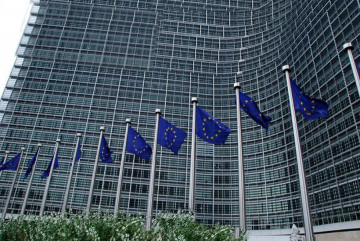
If you walk around London today, you will notice that the 12 star flag of the EU is flying all over the place. That is because this is Schuman day. It is the birthday of the founder of this project, and the elites have decreed that it should be properly marked.
Do we feel loyalty to that flag? Do our hearts pitter-patter as we watch it flutter over public buildings? On the contrary. The British share with other EU populations a growing sense of alienation, which is one of the reasons turn-out at European elections continues to decline.
As Jean-Claude Juncker has himself remarked with disapproval, “too many Europeans are returning to a national or regional mindset”. In the face of that disillusionment, the European elites are doing exactly the wrong thing. Instead of devolving power, they are centralizing.
Instead of going with the grain of human nature and public opinion, they are reaching for the same corrective behavioural therapy as Monnet and Schuman: more legislation, more federal control; and whenever there is a crisis of any kind the cry is always the same. “More Europe, more Europe!”
What did they do when the Berlin wall came down, and the French panicked about the inevitability of German unification? “More Europe!” And what are they saying now, when the ensuing single currency has become a disaster? “More Europe!”
They persist in the delusion that political cohesion can be created by a forcible economic integration, and they are achieving exactly the opposite. What is the distinctive experience of the people of Greece, over the last eight years? It is a complete humiliation, a sense of powerlessness. The suicide rate has risen by 35 per cent; life expectancy has actually fallen. Youth unemployment is around 50 per cent. It is an utter disgrace to our continent.
That is what happens when you destroy democracy. Do the Greeks feel warmer towards the Germans? Do they feel a community of interest? Of course not.
In Austria the far-right have just won an election for the first time since the 1930s. The French National Front are on the march in France, and Marine le Pen may do well in the Presidential elections. You could not say that EU integration is promoting either mutual understanding or moderation, and the economic consequence range from nugatory to disastrous.
The answer to the problems of Europe today is not “more Europe”, if that means more forcible economic and political integration. The answer is reform, and devolution of powers back to nations and people, and a return to intergovernmentalism, at least for this country – and that means Vote Leave on June 23.
And of course there will be some in this country who are rightly troubled by a sense of neighbourly duty. There are Remainers who may agree with much of the above; that the economic advantages for Britain are either overstated or non-existent. But they feel uneasy about pulling out of the EU in its hour of need, when our neighbours are in distress; and at this point they deploy the so-called “Peace in Europe” argument: that if Britain leaves the EU, there will be a return to slaughter on Flanders Fields.
I think this grossly underestimates the way Europe has changed, and the Nato guarantee that has really underpinned peace in Europe. I saw the disaster when the EU was charged with sorting out former Yugoslavia, and I saw how Nato sorted it out.
And it understates the sense in which it is the EU itself, and its anti-democratic tendencies that are now a force for instability and alienation.
Europe faces twin crises of mass migration, and a euro that has proved a disaster for some member states; and the grim truth is that the risks of staying in this unreformed EU are intensifying and not diminishing.
In the next six weeks we must politely but relentlessly put the following questions to the Prime Minister and to the Remain campaign…
1 How can you possibly control EU immigration into this country?
2 The Living Wage is an excellent policy, but how will you stop it being a big pull factor for uncontrolled EU migration, given that it is far higher than minimum wages in other EU countries?
3 How will you prevent the European Court from interfering further in immigration, asylum, human rights, and all kinds of matters which have nothing to do with the so-called Single Market?
4 Why did you give up the UK veto on further moves towards a fiscal and political union?
5 How can you stop us from being dragged in, and from being made to pay?
The answer is that the Remain campaign have no answers to any of these questions, because they are asking us to remain in an EU that is wholly unreformed, and going in the wrong direction.
If we leave on June 23, we can still provide leadership in so many areas. We can help lead the discussions on security, on counter-terrorism, on foreign and defence policy, as we always have. But all those conversation can be conducted within an intergovernmental framework, and without the need for legal instruments enforced by the European Court of Justice. We will still be able to cooperate on the environment, on migration, on science and technology; we will still have exchanges of students.
We will trade as much as ever before, if not more. We will be able to love our fellow Europeans, marry them, live with them, share the joy of discovering our different cultures and languages – but we will not be subject to the jurisdiction of a single court and legal system that is proving increasingly erratic and that is imitated by no other trading group.
We will not lose influence in Europe or around the world – on the contrary, you could argue we will gain in clout. We are already drowned out around the table in Brussels; we are outvoted far more than any other country – 72 times in the last 20 years, and ever more regularly since 2010; and the Eurozone now has a built-in majority on all questions.
We will recapture or secure our voice – for the 5th biggest economy in the world – in international bodies such as the WTO or the IMF or the CITES, where the EU is increasingly replacing us and laying a claim to speak on our behalf. If you want final and conclusive proof of our inability to “get our way” in Brussels – and the contempt with which we will be treated if we vote to Remain – look again at the UK deal and the total failure to secure any change of any significance.
Above all – to get to the third key point of the Remainers – if we leave the EU we will not, repeat not, be leaving Europe. Of all the arguments they make, this is the one that infuriates me the most. I am a child of Europe. I am a liberal cosmopolitan and my family is a genetic UN peacekeeping force.
I can read novels in French and I can sing the Ode to joy in German, and if they keep accusing me of being a Little Englander, I will. Both as editor of the Spectator and Mayor of London I have promoted the teaching of modern European languages in our schools. I have dedicated much of my life to the study of the origins of our common – our common -European culture and civilization in ancient Greece and Rome.
So I find if offensive, insulting, irrelevant and positively cretinous to be told – sometimes by people who can barely speak a foreign language – that I belong to a group of small-minded xenophobes; because the truth is it is Brexit that is now the great project of European liberalism, and I am afraid that it is the European Union – for all the high ideals with which it began, that now represents the ancient regime.
It is we who are speaking up for the people, and it is they who are defending an obscurantist and universalist system of government that is now well past its sell by date and which is ever more remote from ordinary voters.
It is we in the Leave Camp – not they – who stand in the tradition of the liberal cosmopolitan European enlightenment – not just of Locke and Wilkes, but of Rousseau and Voltaire; and though they are many, and though they are well-funded, and though we know that they can call on unlimited taxpayer funds for their leaflets, it is we few, we happy few who have the inestimable advantage of believing strongly in our cause, and that we will be vindicated by history; and we will win for exactly the same reason that the Greeks beat the Persians at Marathon – because they are fighting for an outdated absolutist ideology, and we are fighting for freedom.
That is the choice on June 23
It is between taking back control of our money – or giving a further £100bn to Brussels before the next election
Between deciding who we want to come here to live and work – or letting the EU decide
between a dynamic liberal cosmopolitan open global free-trading prosperous Britain, or a Britain where we remain subject to a undemocratic system devised in the 1950s that is now actively responsible for low growth and in some cases economic despair
between believing in the possibility of hope and change in Europe – or accepting that we have no choice but to knuckle under
It is a choice between getting dragged ever further into a federal superstate, or taking a stand now
Vote Leave on June 23, and take back control of our democracy.