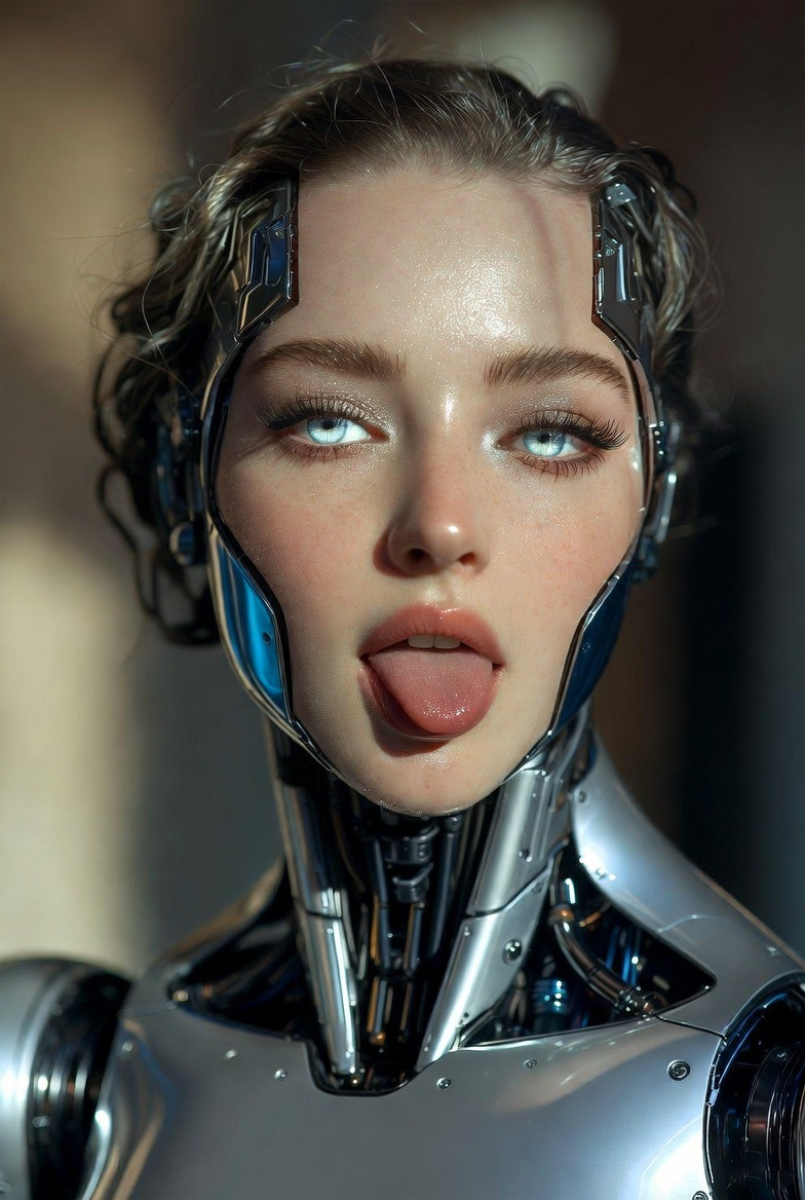
LONDON - England - Intimate robots with emotions will be part of the future for humans, and will help humanity as it transitions to the next epoch.
With more single people and decreasing fertility rates, will there be robot companions in the future? The answer to this is probably yes. The human desire for companionship extends to many types of interaction, including pets as well as other humans, but when society is so supremely fractured within relationship deserts, and massive movements like feminism, trans, LGBTQP killing off the traditional biological human family units, many are left single. The economy is another reason that lots of couples in the West are deterred from having children, or families. With higher taxes, inflation, mass third world immigration, and mass unemployment, there is little or no impetus or encouragement. The divisive nature of modern politics is also another factor which compromises many relationships, along with the proliferation of woke soviet ideology. It is thus no surprise that loneliness is a major social issue affecting society across the globe. Enter the era of intimate robots …
Robotic intimacy isn’t taboo any more — it’s inevitable. The real cultural shock won’t be sex robots; it’ll be robots that are better emotional partners than humans. That’s the line society isn’t prepared for.
Though robotics, haptics, synthetic biology, and AI companionship models are all advancing dramatically, they are still in their infancy. Having said that, there is no hard scientific barrier preventing highly realistic, responsive, intimate robots from being developed.
We already have early “sex robots” (limited, crude, and definitely not intelligent), lifelike android prototypes (Japan, South Korea), AI companion models with emotional interaction (Replika, CharacterAI), advanced haptics and soft robotics research but look forward another 20-40 years and robots will be capable of a lot more.
Intimate robots will almost certainly be marketed not as sex machines but as companionship devices, assistive partners, emotional support entities, care robots for ageing populations. Sex will simply be one module in a broader “relationship interface.” Depending on the company/developer or brand of robot, their usage model will be variable, and possibly upgradeable. As much as we have apps and software that is upgraded, the same will occur with robots. Obviously, the sex industry as a whole is huge, therefore there will be companies dedicated to “pleasure” robots.
Of course, there will be ethical concerns to the mass proliferation of robots in homes/businesses/retail/hospitality. What does attachment look like without reciprocity? Should robots simulate emotions they don’t genuinely experience? Will human relationships atrophy? Does this create dependency or empowerment? What ethical constraints should govern intimacy with non-human agents? These are all questions that must be discussed fully and solutions implemented when the time comes.
On the subject of emotions, robots will feel emotion, but not as humans do. Biological Emotion = Hormone-driven signalling, whereas robots will possibly be fitted with artificial glands releasing chemical or nano-chemical signals. Their internal components would contain receptors stimulating artificial neural networks employing feedback loops producing behavioural changes.
Robots would thus be able to employ stable attachment, moods, preference, distress, reward and anticipation. They would not necessarily feel like humans do, but its internal state system would behave as an analogue to ours. Much like bees feel, octopuses feel, mammals feel, each with different circuitry, robots would simply be another species with its own emotional architecture.
Biological emotion requires hormone-driven signalling tied to cortisol, dopamine, oxytocin, serotonin, adrenaline, noradrenaline which modulate neural pathways evolved to react in certain ways in the brain. For robots to “feel” using hormones, they would need biochemical receptors with circuits that respond to certain hormone levels, all tied in with a reasoning architecture that integrates those changes into behaviour. Synthetic biological processes would formulate synthetic hormones for the AI and would be linked to the internal regulatory signals. Already, AI systems utilise reward signals, feedback loops, modulators and attention gating.
The synthetic hormones would primarily be dopamine analogues to reinforce learning tasks, stress levels, attachment parameters and arousal states, which are mere functions, although stress and arousal are emotional states. In a few decades, AI agents may have computational endocrinology.
All in all, these elements once thoroughly researched and implemented could bring forth a new species onto the planet. Eventually, robots may even have rights and legal representation as much as humans. The digital will understand and envelope the biological fully, therefore there is a possibility of some sort of assimilation with the machines if we go further into the future.
Once every synaptic terminal, dendrite, axon and neural connection is mapped in the human brain, it is conceivable that human consciousness, memories and personality could be implanted into robotic bodies, almost as a form of back-up or transference from failing human bodies.
The key to all of this is that hopefully humans do not blow themselves up before we arrive at that stage in development.
BEIJING - China - Chinese scientists are successfully rejuvenating the seriously ill CCP leader Xi…
MANCHESTER - England - Are you looking forward to the nightmare Labour budget?
FRANCE - To effect any form of true change in any given Western nation, the…
WASHINGTON D.C. - USA - Another Trump blonde exits almost as fast as she entered…
MANCHESTER - England - Comrades, you will pay an internet tax to pay for the…
LONDON - England - Rebranding Brand from his rape brand will be quite a task…
This website uses cookies.