



Speaking at a recent lecture at the Massachusetts Institute of Technology, Professor Edelweiss Applebaum, said: “Birds are getting too lazy to fly, some don’t even bother laying eggs anymore. That’s why there have been incidents of birds simply falling out of the sky, they get too lazy and forget to flap. This is a biological disaster and our research still has to find out why birds are getting all lazy.”
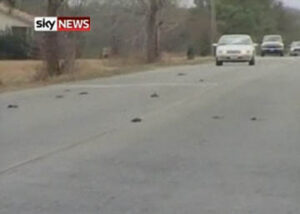
Thousands of blackbirds fell out of the sky on New Year’s Eve in 2010 causing mayhem on the Arkansas streets. All over the world there have been similar multiple bird deaths and now that scientists have pinpointed the problem they need to find ways to prevent birds from getting bored and lazy.
“If we attach big TV screens to balloons and float them in increments of 100 feet all the way up to high altitude, the birds will have something to watch when they’re flying around. This way, they would be engaged and not bored out of their frickin’ minds. Just think about it, say you have to migrate to the Southern horn of Africa every year from Europe. That is a boring flight, there are no in-flight movies for these guys, and that’s a 6,000 mile trip one way. We need to also put public service announcements on the films so the birds remember to flap their wings. I know it can be done. We have already tested the balloons out on numerous species of bird and they definitely seem more flighty.”
The only barrier for the distribution of the bird balloon screens is the inhibitive cost. To implement the whole project worldwide would cost $560 billion and a yearly maintenance cost of $34 billion. There are also fears that airplanes and other air traffic could accidentally crash into the bird balloons, but a system of sophisticated beacons installed on each system could warn pilots within 3 km of each balloon.
President Obama and Angela Merkel are set to discuss the implementation of the project next month at a special consortium for world wildlife preservation in Detroit, Michigan.





Let them eat Pop corn then
Maybe the Republicans will get too lazy to be stupid and we can get back to governing the nation.
Wow, this would create loads of jobs and help the worldwide economic recovery! Let's hope the birds keep getting lazier! Maybe fish will start getting too lazy to swim – the mind boggles with economic opportunities. So what if the aircraft crash into the flying tv screens? Plenty of aircraft have killed birds, no wonder they don't want to fly anymore. It's all about the birds and economic recovery now. Thanks you birdies!
I can believe this because of the chemicals that are being pumped into the atmosphere.